Indigenous peoples of the Americas


.svg.png)


The Indigenous peoples of the Americas are the peoples who are native to the Americas or the Western Hemisphere. Their ancestors are among the pre-Columbian population of South or North America, including Central America and the Caribbean. Indigenous peoples live throughout the Americas. While often minorities in their countries, Indigenous peoples are the majority in Greenland[36] and close to a majority in Bolivia[37] and Guatemala.[38]
There are at least 1,000 different Indigenous languages of the Americas. Some languages, including Quechua, Arawak, Aymara, Guaraní, Nahuatl, and some Mayan languages, have millions of speakers and are recognized as official by governments in Bolivia, Peru, Paraguay, and Greenland.
Indigenous peoples, whether residing in rural or urban areas, often maintain aspects of their cultural practices, including religion, social organization, and subsistence practices. Over time, these cultures have evolved, preserving traditional customs while adapting to modern needs. Some Indigenous groups remain relatively isolated from Western culture, with some still classified as uncontacted peoples.
The Americas also host millions of individuals of mixed Indigenous, European, and sometimes African or Asian descent, historically referred to as mestizos in Spanish-speaking countries.[39][40] In many Latin American nations, people of partial Indigenous descent constitute a majority or significant portion of the population, particularly in Central America, Mexico, Peru, Bolivia, Ecuador, Colombia, Venezuela, Chile, and Paraguay.[41][42][43] Mestizos outnumber Indigenous peoples in most Spanish-speaking countries, according to estimates of ethnic cultural identification. However, since Indigenous communities in the Americas are defined by cultural identification and kinship rather than ancestry or race, mestizos are typically not counted among the Indigenous population unless they speak an Indigenous language or identify with a specific Indigenous culture.[44] Additionally, many individuals of wholly Indigenous descent who do not follow Indigenous traditions or speak an Indigenous language have been classified or self-identified as mestizo due to assimilation into the dominant Hispanic culture. In recent years, the self-identified Indigenous population in many countries has increased as individuals reclaim their heritage amid rising Indigenous-led movements for self-determination and social justice.[45]
In past centuries, Indigenous peoples had diverse societal, governmental, and subsistence systems. Some Indigenous peoples were historically hunter-gatherers, while others practiced agriculture and aquaculture. Various Indigenous societies developed complex social structures, including precontact monumental architecture, organized cities, city-states, chiefdoms, states, monarchies, republics, confederacies, and empires.[46] These societies possessed varying levels of knowledge in fields such as engineering, architecture, mathematics, astronomy, writing, physics, medicine, agriculture, irrigation, geology, mining, metallurgy, art, sculpture, and goldsmithing.
Terminology

_2007.jpg)

Application of the term "Indian" originated with Christopher Columbus, who, when searching for India, made landfall in the Americas but thought he had arrived in the East Indies.[47][48][49][50][51][52]
The islands came to be known as the "West Indies" (or "Antilles"), a name that is still used to describe the islands. This led to the blanket term "Indies" and "Indians" (Spanish: indios; Portuguese: índios; French: indiens; Dutch: indianen) for the Indigenous inhabitants, which implied some kind of ethnic or cultural unity among the Indigenous peoples of the Americas. This unifying concept, codified in law, religion, and politics, was not originally accepted by the myriad groups of Indigenous peoples themselves but has since been embraced or tolerated by many over the last two centuries.[53] The term First Nations is used in Canada to identify that type of Indigenous people.
The term "Indian" (or First Nations in Canada) generally does not include the culturally and linguistically distinct Indigenous peoples of the Arctic regions of the Americas, including the Aleuts, Inuit, or Yupik peoples. These peoples entered the continent as a second, more recent wave of migration several thousand years later and have much more recent genetic and cultural commonalities with the Indigenous peoples of Siberia. However, these groups are nonetheless considered among the "Indigenous peoples of the Americas".[54]
The term Amerindian, a portmanteau of "American Indian", was coined in 1902 by the American Anthropological Association. It has been controversial ever since its creation. It was immediately rejected by some leading members of the Association, and, while adopted by many, it was never universally accepted.[55] While never popular in Indigenous communities themselves, it remains a preferred term among some anthropologists, notably in some parts of Canada and the English-speaking Caribbean.[56][57][58][59]
"Indigenous peoples in Canada" is used as the collective name for First Nations, Inuit, and Métis.[60][61] The term Aboriginal peoples as a collective noun (also describing First Nations, Inuit, and Métis) is a specific term of art used in some legal documents, including the Constitution Act, 1982.[62] Over time, as societal perceptions and government–indigenous relationships have shifted, many historical terms have changed definitions or been replaced as they have fallen out of favor.[63] The use of the term "Indian" is frowned upon because it represents the imposition and restriction of Indigenous peoples and cultures by the Canadian Government.[63] The terms "Native" and "Eskimo" are generally regarded as disrespectful (in Canada), and so are rarely used unless specifically required.[64] While "Indigenous peoples" is the preferred term, many individuals or communities may choose to describe their identity using a different term.[63][64]
The Métis people of Canada can be contrasted, for instance, to the Indigenous-European mixed-race mestizos (or caboclos in Brazil) of Hispanic America whose large populations constitute outright majorities, pluralities, or at the least large minorities in most Latin American countries. They identify largely as an ethnic group distinct from Europeans and Indigenous, but consider themselves a subset of the European-derived Hispanic or Brazilian peoplehood in culture and ethnicity (cf. ladinos).
Among Spanish-speaking countries, indígenas or pueblos indígenas ("Indigenous peoples") is a common term, though nativos or pueblos nativos ('native peoples') may also be heard; moreover, aborigen ('aborigine') is used in Argentina and pueblos originarios ('original peoples') is common in Chile. In Brazil, indígenas and povos originários ("Indigenous peoples") are common formal-sounding designations, while índio ('Indian') is still the more often heard term (the noun for the South-Asian nationality being indiano), but since the early 2010s has been considered offensive and pejorative. Aborígene and nativo are rarely used in Brazil in Indigenous-specific contexts (e.g., aborígene is usually understood as the ethnonym for Indigenous Australians). The Spanish and Portuguese equivalents to Indian, nevertheless, could be used to mean any hunter-gatherer or full-blooded Indigenous person, particularly to continents other than Europe or Africa—for example, indios filipinos.
Indigenous peoples of the United States are commonly known as Native Americans, Indians, as well as Alaska Natives. The term "Indian" is still used in some communities and remains in use in the official names of many institutions and businesses in Indian Country.[65]
Name controversy


The various nations, tribes, and bands of Indigenous peoples of the Americas have differing preferences in terminology for themselves.[66] While there are regional and generational variations in which umbrella terms are preferred for Indigenous peoples as a whole, in general, most Indigenous peoples prefer to be identified by the name of their specific nation, tribe, or band.[66][67]
Early settlers often adopted terms that some tribes used for each other, not realizing these were derogatory terms used by enemies. When discussing broader subsets of peoples, naming has often been based on shared language, region, or historical relationship.[68] Many English exonyms have been used to refer to the Indigenous peoples of the Americas. Some of these names were based on foreign language terms used by earlier explorers and colonists, while others resulted from the colonists' attempts to translate or transliterate endonyms from the native languages. Other terms arose during periods of conflict between the colonists and Indigenous peoples.[69]
Since the late 20th century, Indigenous peoples in the Americas have been more vocal about how they want to be addressed, pushing to suppress the use of terms widely considered to be obsolete, inaccurate, or racist. During the latter half of the 20th century and the rise of the Indian rights movement, the United States federal government responded by proposing the use of the term "Native American", to recognize the primacy of Indigenous peoples' tenure in the nation.[70] As may be expected among people of over 400 different cultures in the US alone, not all of the people intended to be described by this term have agreed on its use or adopted it. No single group naming convention has been accepted by all Indigenous peoples in the Americas. Most prefer to be addressed as people of their tribe or nations when not speaking about Native Americans/American Indians as a whole.[71]
Since the 1970s, the word "Indigenous", which is capitalized when referring to people, has gradually emerged as a favored umbrella term. The capitalization is to acknowledge that Indigenous peoples have cultures and societies that are equal to Europeans, Africans, and Asians.[67][72] This has recently been acknowledged in the AP Stylebook.[73] Some consider it improper to refer to Indigenous people as "Indigenous Americans" or to append any colonial nationality to the term because Indigenous cultures existed before European colonization. Indigenous groups have territorial claims that are different from modern national and international borders, and when labeled as part of a country, their traditional lands are not acknowledged. Some who have written guidelines consider it more appropriate to describe an Indigenous person as "living in" or "of" the Americas, rather than calling them "American"; or simply calling them "Indigenous" without any addition of a colonial state.[74][75]
History
Peopling of the Americas

It is believed that the peopling of the Americas began when Paleolithic hunter-gatherers (Paleo-Indians) entered North America from the North Asian Mammoth steppe via the Beringia land bridge, which had formed between northeastern Siberia and western Alaska due to the lowering of sea level during the Last Glacial Maximum (26,000 to 19,000 years ago).[77] These populations expanded south of the Laurentide Ice Sheet and spread rapidly southward, occupying both North and South America no later than 14,000 years ago, and possibly even before 20,000 years ago.[78][79][80][81][82] The earliest populations in the Americas, before roughly 10,000 years ago, are known as Paleo-Indians. Indigenous peoples of the Americas have been linked to Siberian populations by proposed linguistic factors, the distribution of blood types, and in genetic composition as reflected by molecular data, such as DNA.[83][84]
While there is general agreement that the Americas were first settled from Asia, the pattern of migration and the place(s) of origin in Eurasia of the peoples who migrated to the Americas remain unclear.[79] The traditional theory is that Ancient Beringians moved when sea levels were significantly lowered due to the Quaternary glaciation,[85][86] following herds of now-extinct Pleistocene megafauna along ice-free corridors that stretched between the Laurentide and Cordilleran ice sheets.[87] Another route proposed is that, either on foot or using boats, they migrated down the Pacific coast to South America as far as Chile.[88] Any archaeological evidence of coastal occupation during the last Ice Age would now have been covered by the sea level rise, up to a hundred metres since then.[89]
The precise date for the peopling of the Americas is a long-standing open question. While advances in archaeology, Pleistocene geology, physical anthropology, and DNA analysis have progressively shed more light on the subject, significant questions remain unresolved.[90][91] The Clovis First theory refers to the hypothesis that the Clovis culture represents the earliest human presence in the Americas about 13,000 years ago.[92] Evidence of pre-Clovis cultures has accumulated and pushed back the possible date of the first peopling of the Americas.[93][94][95][96] Academics generally believe that humans reached North America south of the Laurentide Ice Sheet at some point between 15,000 and 20,000 years ago.[90][93][97][98][99][100] Some new controversial archaeological evidence suggests the possibility that human arrival in the Americas may have occurred prior to the Last Glacial Maximum more than 20,000 years ago.[93][101][102][103][104][105]Pre-Columbian era


_-_49503469491.jpg)
While technically referring to the era before Christopher Columbus' voyages of 1492 to 1504, in practice the term usually includes the history of Indigenous cultures until Europeans either conquered or significantly influenced them.[106] "Pre-Columbian" is used especially often in the context of discussing the pre-contact Mesoamerican Indigenous societies: Olmec; Toltec; Teotihuacano' Zapotec; Mixtec; Aztec and Maya civilizations; and the complex cultures of the Andes: Inca Empire, Moche culture, Muisca Confederation, and Cañari.
The pre-Columbian era refers to all period subdivisions in the history and prehistory of the Americas before the appearance of significant European and African influences on the American continents, spanning the time of the original arrival in the Upper Paleolithic to European colonization during the early modern period.[107] The Norte Chico civilization (in present-day Peru) is one of the defining six original civilizations of the world, arising independently around the same time as that of Egypt.[108][109] Many later pre-Columbian civilizations achieved great complexity, with hallmarks that included permanent or urban settlements, agriculture, engineering, astronomy, trade, civic and monumental architecture, and complex societal hierarchies. Some of these civilizations had long faded by the time of the first significant European and African arrivals (ca. late 15th–early 16th centuries), and are known only through oral history and through archaeological investigations. Others were contemporary with the contact and colonization period and were documented in historical accounts of the time. A few, such as the Mayan, Olmec, Mixtec, Aztec, and Nahua peoples, had their written languages and records. However, the European colonists of the time worked to eliminate non-Christian beliefs and burned many pre-Columbian written records. Only a few documents remained hidden and survived, leaving contemporary historians with glimpses of ancient culture and knowledge.
According to both Indigenous and European accounts and documents, American civilizations before and at the time of European encounter had achieved great complexity and many accomplishments.[110] For instance, the Aztecs built one of the largest cities in the world, Tenochtitlan (the historical site of what would become Mexico City), with an estimated population of 200,000 for the city proper and a population of close to five million for the extended empire.[111] By comparison, the largest European cities in the 16th century were Constantinople and Paris with 300,000 and 200,000 inhabitants respectively.[112] The population in London, Madrid, and Rome hardly exceeded 50,000 people. In 1523, right around the time of the Spanish conquest, the entire population in the country of England was just under three million people.[113] This fact speaks to the level of sophistication, agriculture, governmental procedure, and rule of law that existed in Tenochtitlan, needed to govern over such a large citizenry. Indigenous civilizations also displayed impressive accomplishments in astronomy and mathematics, including the most accurate calendar in the world. The domestication of maize or corn required thousands of years of selective breeding, and continued cultivation of multiple varieties was done with planning and selection, generally by women.
Inuit, Yupik, Aleut, and Indigenous creation myths tell of a variety of origins of their respective peoples. Some were "always there" or were created by gods or animals, some migrated from a specified compass point, and others came from "across the ocean".[114]
European colonization


The European colonization of the Americas fundamentally changed the lives and cultures of the resident Indigenous peoples. Although the exact pre-colonization population count of the Americas is unknown, scholars estimate that Indigenous populations diminished by between 80% and 90% during the first centuries of European colonization. Most scholars estimate a pre-colonization population of around 50 million, with other scholars arguing for an estimate of 100 million. Estimates reach as high as 145 million.[115][116][117] William Denevan estimates of the pre-contact population range from 8 million to 112 million, falling to under 6 million by 1650.[118]
Epidemics ravaged the Americas with diseases, such as smallpox, measles, and cholera, which the early colonists brought from Europe. The spread of infectious diseases was slow initially, as European populations were relatively small. This changed when the Europeans began the trafficking of massive numbers of enslaved Western and Central African people to the Americas, drastically increasing the population. These enslaved Africans carried many of the same diseases as Europeans, such as smallpox, along with many tropical diseases unknown to both the indigenous populations and Europeans. In 1520, an African who had been infected with smallpox had arrived in Yucatán. By 1558, the disease had spread throughout South America and had arrived at the Plata basin.[119] Colonist violence towards Indigenous peoples accelerated the loss of lives. European colonists perpetrated massacres on the Indigenous peoples and enslaved them.[120][121][122] According to the U.S. Bureau of the Census (1894), the North American Indian Wars of the 19th century had a known death toll of about 19,000 Europeans and 30,000 Native Americans, and an estimated total death toll of 45,000 Native Americans.[123]
The first Indigenous group encountered by Columbus, the 250,000 Taínos of Hispaniola, represented the dominant culture in the Greater Antilles and the Bahamas. Within thirty years about 70% of the Taínos had died.[124] They had no immunity to European diseases, so outbreaks of measles and smallpox ravaged their population.[125] One such outbreak occurred in a camp of enslaved Africans, where smallpox spread to the nearby Taíno population and reduced their numbers by 50%.[119] Increasing punishment of the Taínos for revolting against forced labor, despite measures put in place by the encomienda, which included religious education and protection from warring tribes,[126] eventually led to the last great Taíno rebellion (1511–1529).
Following years of mistreatment, the Taínos began to adopt suicidal behaviors, with women aborting or killing their infants and men jumping from cliffs or ingesting untreated cassava, a violent poison.[124] Eventually, a Taíno Cacique named Enriquillo managed to hold out in the Baoruco Mountain Range for thirteen years, causing serious damage to the Spanish, Carib-held plantations and their Indian auxiliaries.[127] Hearing of the seriousness of the revolt, Emperor Charles V (also King of Spain) sent Captain Francisco Barrionuevo to negotiate a peace treaty with the ever-increasing number of rebels. Two months later, after consultation with the Audencia of Santo Domingo, Enriquillo was offered any part of the island to live in peace.
The Laws of Burgos, 1512–1513, were the first codified set of laws governing the behavior of Spanish settlers in America, particularly concerning Indigenous peoples. The laws forbade the maltreatment of them and endorsed their conversion to Catholicism.[128] The Spanish crown found it difficult to enforce these laws in distant colonies.
Epidemic disease was the overwhelming cause of the population decline of the Indigenous peoples.[129][130] After initial contact with Europeans and Africans, Old World diseases caused the deaths of 90 to 95% of the native population of the New World in the following 150 years.[131] Smallpox killed from one-third to half of the native population of Hispaniola in 1518.[132][133] By killing the Incan ruler Huayna Capac, smallpox caused the Inca Civil War of 1529–1532. Smallpox was only the first epidemic. Typhus (probably) in 1546, influenza and smallpox together in 1558, smallpox again in 1589, diphtheria in 1614, and measles in 1618—all ravaged the remains of Inca culture.
Smallpox killed millions of native inhabitants of Mexico.[134][135] Unintentionally introduced at Veracruz with the arrival of Pánfilo de Narváez on 23 April 1520, smallpox ravaged Mexico in the 1520s,[136] possibly killing over 150,000 in Tenochtitlán (the heartland of the Aztec Empire) alone, and aiding in the victory of Hernán Cortés over the Aztec Empire at Tenochtitlan (present-day Mexico City) in 1521.[119]
There are many factors as to why Indigenous peoples suffered such immense losses from Afro-Eurasian diseases. Many Old World diseases, like cow pox, are acquired from domesticated animals that are not indigenous to the Americas. European populations had adapted to these diseases, and built up resistance, over many generations. Many of the Old World diseases that were brought over to the Americas were diseases, like yellow fever, that were relatively manageable if infected as a child, but were deadly if infected as an adult. Children could often survive the disease, resulting in immunity to the disease for the rest of their lives. But contact with the disease by adults without this childhood or inherited immunity often proved fatal.[119][137]
Colonization of the Caribbean led to the destruction of the Arawaks of the Lesser Antilles. Their culture was destroyed by 1650. Only 500 had survived by the year 1550, though the bloodlines continued through to the modern populace. In Amazonia, Indigenous societies weathered centuries of colonization and genocide.[138]
Contact with European diseases such as smallpox and measles killed between 50 and 67 percent of the Indigenous population of North America in the first hundred years after the arrival of Europeans.[139] Some 90 percent of the native population near Massachusetts Bay Colony died of smallpox in an epidemic in 1617–1619.[140] In 1633, in Fort Orange (New Netherland), the Native Americans there were exposed to smallpox because of contact with Europeans. As it had done elsewhere, the virus wiped out entire population groups of Native Americans.[141] It reached Lake Ontario in 1636, and the lands of the Iroquois by 1679.[142][143] During the 1770s smallpox killed at least 30% of the West Coast Native Americans.[144] The 1775–82 North American smallpox epidemic and the 1837 Great Plains smallpox epidemic brought devastation and drastic population depletion among the Plains Indians.[145][146] In 1832 the federal government of the United States established a smallpox vaccination program for Native Americans (The Indian Vaccination Act of 1832).[147]
The Indigenous peoples in Brazil declined from a pre-Columbian high of an estimated three million[148] to some 300,000 in 1997.[149]
The Spanish Empire and other Europeans re-introduced horses to the Americas. Some of these animals escaped and began to breed and increase their numbers in the wild.[150] The reintroduction of the horse, extinct in the Americas for over 7500 years, had a profound impact on Indigenous cultures in several regions, such as those of the Great Plains, the Northwest Plateau, the Great Basin, Aridoamerica, the Gran Chaco and the Southern Cone. By domesticating horses, some tribes had great success: horses enabled them to expand their territories, exchange more goods with neighboring tribes, and more easily capture game, such as bison.
According to Erin McKenna and Scott L. Pratt, the Indigenous population of the Americas was 145 million in the late 15th and by the late 17th century, had been reduced to 15 million due to epidemics, wars, massacres, mass rapes, starvation, and enslavement.[117]
Indigenous historical trauma
Indigenous historical trauma (IHT) is the trauma that can accumulate across generations and develop as a result of the historical ramifications of colonization and is linked to mental and physical health hardships and population decline.[151] IHT affects many different people in a multitude of ways because the Indigenous community and their history are diverse.
Many studies (such as Whitbeck et al., 2014;[152] Brockie, 2012; Anastasio et al., 2016;[153] Clark & Winterowd, 2012;[154] Tucker et al., 2016)[155] have evaluated the impact of IHT on health outcomes of Indigenous communities from the United States and Canada. IHT is a difficult term to standardize and measure because of the vast and variable diversity of Indigenous people and their communities. Therefore, it is an arduous task to assign an operational definition and systematically collect data when studying IHT. Many of the studies that incorporate IHT measure it in different ways, making it hard to compile data and review it holistically. This is an important point that provides context for the following studies that attempt to understand the relationship between IHT and potential adverse health impacts.
Some of the methodologies to measure IHT include a "Historical Losses Scale" (HLS), "Historical Losses Associated Symptoms Scale" (HLASS), and residential school ancestry studies.[151]: 23 HLS uses a survey format that includes "12 kinds of historical losses", such as loss of language and loss of land and asks participants how often they think about those losses.[151]: 23 The HLASS includes 12 emotional reactions, and asks participants how they feel when they think about these losses.[151] Lastly, the residential school ancestry studies ask respondents if their parents, grandparents, great-grandparents, or "elders from their community" went to a residential school to understand if family or community history in residential schools is associated with negative health outcomes.[151]: 25 In a comprehensive review of the research literature, Joseph Gone and colleagues[151] compiled and compared outcomes for studies using these IHT measures relative to the health outcomes of Indigenous peoples. The study defined negative health outcomes to include such concepts as anxiety, suicidal ideation, suicide attempts, polysubstance abuse, PTSD, depression, binge eating, anger, and sexual abuse.[151]
The connection between IHT and health conditions is complicated because of the difficult nature of measuring IHT, the unknown directionality of IHT and health outcomes, and because the term Indigenous people used in the various samples comprises a huge population of individuals with drastically different experiences and histories. That being said some studies such as Bombay, Matheson, and Anisman (2014),[156] Elias et al. (2012),[157] and Pearce et al. (2008)[158] found that Indigenous respondents with a connection to residential schools have more negative health outcomes (e.g., suicide ideation, suicide attempts, and depression) than those who did not have a connection to residential schools. Additionally, Indigenous respondents with higher HLS and HLASS scores had one or more negative health outcomes.[151] While there are many studies[153][159][154][160][155] that found an association between IHT and adverse health outcomes, scholars continue to suggest that it remains difficult to understand the impact of IHT. IHT needs to be systematically measured. Indigenous people also need to be understood in separate categories based on similar experiences, location, and background as opposed to being categorized as one monolithic group.[151]
Agriculture


Plants

For thousands of years, Indigenous peoples domesticated, bred, and cultivated a large array of plant species. These species now constitute between 50% and 60% of all crops in cultivation worldwide.[161] In certain cases, the Indigenous peoples developed entirely new species and strains through artificial selection, as with the domestication and breeding of maize from wild teosinte grasses in the valleys of southern Mexico. Numerous such agricultural products retain their Native names in the English and Spanish lexicons.
The South American highlands became a center of early agriculture. Genetic testing of the wide variety of cultivars and wild species suggests that the potato has a single origin in the area of southern Peru,[162] from a species in the Solanum brevicaule complex. Over 99% of all modern cultivated potatoes worldwide are descendants of a subspecies indigenous to south-central Chile,[163] Solanum tuberosum ssp. tuberosum, where it was cultivated as long as 10,000 years ago.[164][165] According to Linda Newson, "It is clear that in pre-Columbian times some groups struggled to survive and often suffered food shortages and famines, while others enjoyed a varied and substantial diet."[166]
Persistent drought around AD 850 coincided with the collapse of the Classic Maya civilization, and the famine of One Rabbit (AD 1454) was a major catastrophe in Mexico.[167]

Indigenous peoples of North America began practicing farming approximately 4,000 years ago, late in the Archaic period of North American cultures. Technology had advanced to the point where pottery had started to become common and the small-scale felling of trees had become feasible. Concurrently, the Archaic Indigenous peoples began using fire in a controlled manner. They carried out the intentional burning of vegetation to mimic the effects of natural fires that tended to clear forest understories. It made travel easier and facilitated the growth of herbs and berry-producing plants, which were important both for food and for medicines.[168]
In the Mississippi River valley, Europeans noted that Native Americans managed groves of nut and fruit trees not far from villages and towns and their gardens and agricultural fields. They would have used prescribed burning farther away, in forest and prairie areas.[169]

Many crops first domesticated by Indigenous peoples are now produced and used globally, most notably maize (or "corn") arguably the most important crop in the world.[170] Other significant crops include cassava; chia; squash (pumpkins, zucchini, marrow, acorn squash, butternut squash); the pinto bean, Phaseolus beans including most common beans, tepary beans, and lima beans; tomatoes; potatoes; sweet potatoes; avocados; peanuts; cocoa beans (used to make chocolate); vanilla; strawberries; pineapples; peppers (species and varieties of Capsicum, including bell peppers, jalapeños, paprika, and chili peppers); sunflower seeds; rubber; brazilwood; chicle; tobacco; coca; blueberries, cranberries, and some species of cotton.
Studies of contemporary Indigenous environmental management—including agro-forestry practices among Itza Maya in Guatemala and hunting and fishing among the Menominee of Wisconsin—suggest that longstanding "sacred values" may represent a summary of sustainable millennial traditions.[171]
Animals
Numerous Native American dog breeds have been used by the people of the Americas, such as the Canadian Eskimo dog, the Carolina dog, and the Chihuahua. Some Indigenous peoples in the Great Plains used dogs for pulling travois, while others like the Tahltan bear dog were bred to hunt larger game. Some Andean cultures also bred the Chiribaya to herd llamas. The vast majority of indigenous dog breeds in the Americas went extinct, due to being replaced by dogs of European origin.[172]
The Fuegian dog was a domesticated variation of the culpeo that was raised by several cultures in Tierra del Fuego, like the Selkʼnam and the Yahgan.[173] It was exterminated by Argentine and Chilean settlers, due to supposedly posing as a threat to livestock.[174]
Several bird species, such as turkeys, Muscovy ducks, Puna ibis, and neotropic cormorants were domesticated by various peoples in Mesoamerica and South America to be used for poultry.
In the Andean region, Indigenous peoples domesticated llamas and alpacas to produce fiber and meat. The llama was the only beast of burden in the Americas before European colonization.
Guinea pigs were domesticated from wild cavies to be raised for meat consumption in the Andean region. Guinea pigs are now widely raised in Western society as household pets.
In Oasisamerica, several cultures raised scarlet macaws imported from Mesoamerica for their feathers.[175][176]
In the Maya civilization, stingless bees were domesticated to produce balché.[177]
Cochineal were harvested by Mesoamerican and Andean civilizations for coloring fabrics via carminic acid.[178][179][180]
Culture
Cultural practices in the Americas seem to have been shared mostly within geographical zones where distinct ethnic groups adopt shared cultural traits, similar technologies, and social organizations. An example of such a cultural area is Mesoamerica, where millennia of coexistence and shared development among the peoples of the region produced a fairly homogeneous culture with complex agricultural and social patterns. Another well-known example is the North American plains where until the 19th century several peoples shared the traits of nomadic hunter-gatherers based primarily on bison hunting.
Languages

Indigenous languages in North America have been classified into 56 groups or stock tongues, in which the spoken languages of the various nations may be said to center. In connection with speech, reference may be made to gesture language which was highly developed in parts of this area. Of equal interest is the picture writing especially well developed among the Anishinaabe and Lenape nations.[181]
Writing systems

Beginning in the 1st millennium BCE, pre-Columbian cultures in Mesoamerica developed several Indigenous writing systems (independent of any influence from the writing systems that existed in other parts of the world). The Cascajal Block is perhaps the earliest-known example in the Americas of what may be an extensive written text. The Olmec hieroglyphs tablet has been indirectly dated (from ceramic shards found in the same context) to approximately 900 BCE which is around the same time that the Olmec occupation of San Lorenzo Tenochtitlán began to weaken.[182]
The Maya writing system was logosyllabic (a combination of phonetic syllabic symbols and logograms). It is the only pre-Columbian writing system known to have completely represented the spoken language of its community. It has more than a thousand different glyphs, but a few are variations on the same sign or have the same meaning, many appear only rarely or in particular localities, no more than about five hundred were in use in any given time, and, of those, it seems only about two hundred (including variations) represented a particular phoneme or syllable.[183][184][185]
The Zapotec writing system, one of the earliest in the Americas,[186] was logographic and presumably syllabic.[186] There are remnants of Zapotec writing in inscriptions on some of the monumental architecture of the period, but so few inscriptions are extant that it is difficult to fully describe the writing system. The oldest example of the Zapotec script, dating from around 600 BCE, is on a monument that was discovered in San José Mogote.[187]
Aztec codices (singular codex) are books that were written by pre-Columbian and colonial-era Aztecs. These codices are some of the best primary sources for descriptions of Aztec culture. The pre-Columbian codices are largely pictorial; they do not contain symbols that represent spoken or written language.[188] By contrast, colonial-era codices contain not only Aztec pictograms, but also writing that uses the Latin alphabet in several languages: Classical Nahuatl, Spanish, and occasionally Latin.
Spanish mendicants in the sixteenth century taught Indigenous scribes in their communities to write their languages using Latin letters, and there are a large number of local-level documents in Nahuatl, Zapotec, Mixtec, and Yucatec Maya from the colonial era, many of which were part of lawsuits and other legal matters. Although Spaniards initially taught Indigenous scribes alphabetic writing, the tradition became self-perpetuating at the local level.[189] The Spanish crown gathered such documentation, and contemporary Spanish translations were made for legal cases. Scholars have translated and analyzed these documents in what is called the New Philology to write histories of Indigenous peoples from Indigenous viewpoints.[190]
The Wiigwaasabak, birch bark scrolls on which the Ojibwa, an Anishinaabe) people, wrote complex geometrical patterns and shapes, can also be considered a form of writing, as can Mi'kmaq hieroglyphics.
Aboriginal syllabic writing, or simply syllabics, is a family of abugidas used to write some Indigenous languages of the Algonquian, Inuit, and Athabaskan language families.
Music and art


Indigenous music can vary between cultures, however, there are significant commonalities. Traditional music often centers around drumming and singing. Rattles, clapper sticks, and rasps are also popular percussive instruments, both historically and in contemporary cultures. Flutes are made of river cane, cedar, and other woods. The Apache have a type of fiddle, and fiddles are also found many First Nations and Métis cultures.
The music of the Indigenous peoples of Central Mexico and Central America, like that of the North American cultures, tends to be spiritual ceremonies. It traditionally includes a large variety of percussion and wind instruments such as drums, flutes, sea shells (used as trumpets), and "rain" tubes. No remnants of pre-Columbian stringed instruments were found until archaeologists discovered a jar in Guatemala, attributed to the Maya of the Late Classic Era (600–900 CE); this jar was decorated with imagery depicting a stringed musical instrument, which has since been reproduced. This instrument is one of the very few stringed instruments known in the Americas before the introduction of European musical instruments; when played, it produces a sound that mimics a jaguar's growl.[191]
Visual arts by Indigenous peoples of the Americas comprise a major category in the world art collection. Contributions include pottery, paintings, jewelry, weavings, sculptures, basketry, carvings, and beadwork.[192] Because too many artists were posing as Native Americans and Alaska Natives[193] to profit from the cachet of Indigenous art in the United States, the U.S. passed the Indian Arts and Crafts Act of 1990, requiring artists to prove that they were enrolled in a state or federally recognized tribe. To support the ongoing practice of American Indian, Alaska Native, and Native Hawaiian arts and cultures in the United States,[194] the Ford Foundation, arts advocates, and American Indian tribes created an endowment seed fund and established a national Native Arts and Cultures Foundation in 2007.[195][196]
After the entry of the Spaniards, the process of spiritual conquest was favored, among other things, by the liturgical musical service to which the natives, whose musical gifts came to surprise the missionaries, were integrated. The musical gifts of the natives were of such magnitude that they soon learned the rules of counterpoint and polyphony and even the virtuous handling of the instruments. This helped to ensure that it was not necessary to bring more musicians from Spain, which significantly annoyed the clergy.[197]
The solution that was proposed was not to employ but a certain number of Indigenous people in the musical service, not to teach them counterpoint, not to allow them to play certain instruments (brass breaths, for example, in Oaxaca, Mexico) and, finally, not to import more instruments so that the Indigenous people would not have access to them. The latter was not an obstacle to the musical enjoyment of the natives, who experienced the making of instruments, particularly rubbed strings (violins and double basses) or plucked (third). It is there where we can find the origin of what is now called traditional music whose instruments have their tuning and a typical Western structure.[198]
History and status by continent and country
North America
Canada

Indigenous peoples in Canada (also known as Aboriginals)[200] are the Indigenous peoples within the boundaries of Canada. They comprise the First Nations,[201] Inuit,[202] and Métis,[203] representing roughly 5.0% of the total Canadian population. There are over 600 recognized First Nations governments or bands with distinctive cultures, languages, art, and music.[204][205]
Old Crow Flats and Bluefish Caves are some of the earliest known sites of human habitation in Canada.[206] The characteristics of Indigenous cultures in Canada prior to European colonization included permanent settlements,[207] agriculture,[208] civic and ceremonial architecture,[209] complex societal hierarchies, and trading networks.[210] Métis nations of mixed ancestry originated in the mid-17th century when First Nations and Inuit married Europeans, primarily the French colonizers.[211] First Nations and Métis peoples played a critical part in the development of European colonies in Canada, particularly for their role in assisting Europeans during the North American fur trade.
Various Aboriginal laws, treaties, and legislation have been enacted between European immigrants and Indigenous groups across Canada. The impact of settler colonialism in Canada can be seen in its culture, history, politics, laws, and legislatures.[212] This led to the systematic abolishment of Indigenous languages, traditions, religion and the degradation of Indigenous communities that has been described as a genocide of Indigenous peoples.[213]
The modern Indigenous right to self-government provides for Indigenous self-government in Canada and the management of their historical, cultural, political, health care and economic control aspects within Indigenous communities. National Indigenous Peoples Day recognizes the vast cultures and contributions of Indigenous peoples to the history of Canada.[214] First Nations, Inuit, and Métis peoples of all backgrounds have become prominent figures and have served as role models in the Indigenous community and help to shape the Canadian cultural identity.[215]Greenland
.jpg)
The Greenlandic Inuit (Kalaallisut: kalaallit, Tunumiisut: tunumiit, Inuktun: inughuit) are the Indigenous and most populous ethnic group in Greenland.[216] This means that Denmark has one officially recognized Indigenous group. the Inuit – the Greenlandic Inuit of Greenland and the Greenlandic people in Denmark (Inuit residing in Denmark).
Approximately 89 percent of Greenland's population of 57,695 is Greenlandic Inuit, or 51,349 people as of 2012.[36][217] Ethnographically, they consist of three major groups:
- the Kalaallit of west Greenland, who speak Kalaallisut
- the Tunumiit of Tunu (east Greenland), who speak Tunumiit oraasiat ("East Greenlandic")
- the Inughuit of north Greenland, who speak Inuktun ("Polar Inuit")
Mexico


The territory of modern-day Mexico was home to numerous Indigenous civilizations before the arrival of the Spanish conquistadores: The Olmecs, who flourished from between 1200 BCE to about 400 BCE in the coastal regions of the Gulf of Mexico; the Zapotecs and the Mixtecs, who held sway in the mountains of Oaxaca and the Isthmus of Tehuantepec; the Maya in the Yucatán (and into neighboring areas of contemporary Central America); the Purépecha in present-day Michoacán and surrounding areas, and the Aztecs/Mexica, who, from their central capital at Tenochtitlan, dominated much of the center and south of the country (and the non-Aztec inhabitants of those areas) when Hernán Cortés first landed at Veracruz.
In contrast to what was the general rule in the rest of North America, the history of the colony of New Spain was one of racial intermingling (mestizaje). Mestizos, which in Mexico designate people who do not identify culturally with any Indigenous grouping, quickly came to account for a majority of the colony's population. Today, Mestizos in Mexico of mixed Indigenous and European ancestry (with a minor African contribution) are still a majority of the population. Genetic studies vary over whether Indigenous or European ancestry predominates in the Mexican Mestizo population.[218][219] In the 2020 INEGI census, 23.2 million people (19.4% of the Mexican population aged 3 years and older) self-identified as Indigenous.[2] Somewhat contradictorily, in the same 2020 census, 11.8 million people (9.3% of the Mexican population) were determined to be Indigenous by the Mexican government based on the language spoken in their households.[1] The Indigenous population is distributed throughout the territory of Mexico but is especially concentrated in the Sierra Madre del Sur, the Yucatán Peninsula, and the most remote and difficult-to-access areas, such as the Sierra Madre Oriental, the Sierra Madre Occidental, and neighboring areas.[220] The CDI identifies 62 Indigenous groups in Mexico, each with a unique language.[221][222]
In the states of Chiapas and Oaxaca and the interior of the Yucatán Peninsula, a large amount of the population is of Indigenous descent with the largest ethnic group being Maya with a population of 900,000.[223] Large Indigenous minorities, including Aztecs or Nahua, Purépechas, Mazahua, Otomi, and Mixtecs are also present in the central regions of Mexico. In the Northern and Bajio regions of Mexico, Indigenous people are a small minority.
The General Law of Linguistic Rights of the Indigenous Peoples grants all Indigenous languages spoken in Mexico, regardless of the number of speakers, the same validity as Spanish in all territories in which they are spoken, and Indigenous peoples are entitled to request some public services and documents in their native languages.[224] Along with Spanish, the law has granted them—more than 60 languages—the status of "national languages". The law includes all Indigenous languages of the Americas regardless of origin; that is, it includes the Indigenous languages of ethnic groups non-native to the territory. The National Commission for the Development of Indigenous Peoples recognizes the language of the Kickapoo, who immigrated from the United States[225] and recognizes the languages of the Indigenous refugees from Guatemala.[226] The Mexican government has promoted and established bilingual primary and secondary education in some Indigenous rural communities. Nonetheless, of the Indigenous peoples in Mexico, 93% are either native speakers or bilingual second-language speakers of Spanish with only about 62.4% of them (or 5.4% of the country's population) speaking an Indigenous language and about a sixth do not speak Spanish (0.7% of the country's population).[227]

The Indigenous peoples in Mexico have the right of free determination under the second article of the constitution. According to this article, the Indigenous peoples are granted:[228]
- the right to decide the internal forms of social, economic, political, and cultural organization;
- the right to apply their normative systems of regulation as long as human rights and gender equality are respected;
- the right to preserve and enrich their languages and cultures;
- the right to elect representatives before the municipal council in which their territories are located;
amongst other rights.
United States


Indigenous peoples in what is now the contiguous United States, including their descendants, were commonly called American Indians, or simply Indians domestically and since the late 20th century the term Native American came into common use. In Alaska, Indigenous peoples belong to 11 cultures with 11 languages. These include the St. Lawrence Island Yupik, Iñupiat, Athabaskan, Yup'ik, Cup'ik, Unangax, Alutiiq, Eyak, Haida, Tsimshian, and Tlingit,[229] and are collectively called Alaska Natives. They include Native American peoples as well as Inuit, who are distinct but occupy areas of the region.
The United States has authority over Indigenous Polynesian people, which include Hawaiians, Marshallese (Micronesian), and Samoan; politically they are classified as Pacific Islander Americans. They are geographically, genetically, and culturally distinct from Indigenous peoples of the mainland continents of the Americas.
In the 2020 census 2.9% of the U.S. population claimed to have some degree of Native American heritage. When answering a question about racial background, 3.7 million people identified solely as "American Indian or Alaska Native", while another 5.9 million did so in combination with other races.[230] Aztecs were the largest single Native American group in the 2020 census, while Cherokee was the largest group in combination with any other race.[231] Tribes have established their criteria for membership, which are often based on blood quantum, lineal descent, or residency. A minority of Native Americans live in land units called Indian reservations.
Some California and Southwestern tribes, such as the Kumeyaay, Cocopa, Pascua Yaqui, Tohono O'odham, and Apache, span both sides of the US–Mexican border. By treaty, Haudenosaunee people have the legal right to freely cross the US–Canada border. Athabascan, Tlingit, Haida, Tsimshian, Iñupiat, Blackfeet, Nakota, Cree, Anishinaabe, Huron, Lenape, Mi'kmaq, Penobscot, and Haudenosaunee, among others, live in both Canada and the United States, whose international border intersects their common cultural territory.
Central America
Belize
Mestizos (mixed European-Indigenous) number about 34% of the population; unmixed Maya make up another 10.6% (Kekchi, Mopan, and Yucatec). The Garifuna, who came to Belize in the 19th century from Saint Vincent and the Grenadines, have mixed African, Carib, and Arawak ancestry and make up another 6% of the population.[232]
Costa Rica
There are over 114,000 inhabitants of Native American origins, representing 2.4% of the population. Most of them live in secluded reservations, distributed among eight ethnic groups: Quitirrisí (In the Central Valley), Matambú or Chorotega (Guanacaste), Maleku (Northern Alajuela), Bribri (Southern Atlantic), Cabécar (Cordillera de Talamanca), Boruca (Southern Costa Rica) and Ngäbe (Southern Costa Rica along the Panamá border).
These native groups are characterized by their work in wood, like masks, drums, and other artistic figures, as well as fabrics made of cotton.
El Salvador

Estimates for El Salvador's Indigenous population vary. The 2024 census found that 1.2% of the population, or 68,148 people identified as Indigenous.[21] Historically, estimates have claimed higher amounts. A 1930 census stated that 5.6% were Indigenous.[233] By the mid-20th century, there may have been as much as 20% (or 400,000) that would qualify as "Indigenous". Another estimate stated that by the late 1980s, 10% of the population was Indigenous, and another 89% was mestizo (or people of mixed European and Indigenous ancestry).[234]
Much of El Salvador was home to various Indigenous groups like the Pipil, the Lenca, Mayas (Chorti and Poqomam), Chorotegas, and Xincas. The Pipil lived in western El Salvador, spoke Nawat, and had many settlements there, most notably Cuzcatlan. The Pipil had no precious mineral resources, but they did have rich and fertile land that was good for farming. The Spaniards were disappointed not to find gold or jewels in El Salvador as they had in other lands like Guatemala or Mexico, but upon learning of the fertile land in El Salvador, they attempted to conquer it. Noted Meso-American Indigenous warriors to rise militarily against the Spanish included Princes Atonal and Atlacatl of the Pipil people in central El Salvador and Princess Antu Silan Ulap of the Lenca people in eastern El Salvador, who saw the Spanish not as gods but as barbaric invaders. After fierce battles, the Pipil successfully fought off the Spanish army led by Pedro de Alvarado along with their Indigenous allies (the Tlaxcalas), sending them back to Guatemala. After many other attacks with an army reinforced with Indigenous allies, the Spanish were able to conquer Cuzcatlan. After further attacks, the Spanish also conquered the Lenca people. Eventually, the Spaniards intermarried with Pipil and Lenca women, resulting in the mestizo population that would make up the vast majority of the Salvadoran people. Today many Pipil and other Indigenous populations live in the many small towns of El Salvador like Izalco, Panchimalco, Sacacoyo, and Nahuizalco.
Guatemala

.jpg)
Guatemala has one of the largest Indigenous populations in Central America, with approximately 43.6% of the population considering themselves Indigenous.[235] The Indigenous demographic portion of Guatemala's population consists of a majority of Maya groups and one non-Maya group. The Mayan language-speaking portion makes up 29.7% of the population and is distributed into 23 groups namely Q'eqchi' 8.3%, K'iche 7.8%, Mam 4.4%, Kaqchikel 3%, Q'anjob'al 1.2%, Poqomchi' 1%, and Other 4%.[235] The non-Maya group consists of the Xinca who are another set of Indigenous people making up 1.8% of the population.[235] Other sources indicate that between 50% and 60% of the population could be Indigenous because part of the Mestizo population is predominantly Indigenous.
The Maya peoples cover a vast geographic area throughout Central America and expand beyond Guatemala into other countries. One could find vast groups of Maya people in Boca Costa, in the Southern portions of Guatemala, as well as the Western Highlands living together in close communities.[236] Within these communities and outside of them, around 23 Indigenous languages (or Native American Indigenous languages) are spoken as a first language. Of these 23 languages, they only received official recognition by the Government in 2003 under the Law of National Languages.[235] The Law on National Languages recognizes 23 Indigenous languages including Xinca, enforcing that public and government institutions not only translate but also provide services in said languages.[237] It would provide services in Cakchiquel, Garifuna, Kekchi, Mam, Quiche, and Xinca.[238]
The Law of National Languages has been an effort to grant and protect Indigenous peoples' rights not afforded to them previously. Along with the Law of National Languages passed in 2003, in 1996 the Guatemalan Constitutional Court had ratified the ILO Convention 169 on Indigenous and Tribal Peoples.[239] The ILO Convention 169 on Indigenous and Tribal Peoples, is also known as Convention 169. Which is the only International Law regarding Indigenous peoples that Independent countries can adopt. The convention establishes that governments like Guatemala must consult with Indigenous groups before any projects occur on tribal lands.[240]
Honduras
About 5 percent of the population is of full-blooded Indigenous descent, but as much as 80 percent of Hondurans are mestizo or part-Indigenous with European admixture, and about 10 percent are of Indigenous or African descent.[241] The largest concentrations of Indigenous communities in Honduras are in the westernmost areas facing Guatemala and along the coast of the Caribbean Sea, as well as on the border with Nicaragua.[241] The majority of Indigenous people are Lencas, Miskitos to the east, Mayas, Pech, Sumos, and Tolupan.[241]
Nicaragua
About 5 percent of the Nicaraguan population is Indigenous. The largest Indigenous group in Nicaragua is the Miskito people. Their territory extended from Cabo Camarón, Honduras, to La Cruz de Rio Grande, Nicaragua along the Mosquito Coast. There is a native Miskito language, but large numbers speak Miskito Coast Creole, Spanish, Rama, and other languages. Their use of Creole English came about through frequent contact with the British, who colonized the area. Many Miskitos are Christians. Traditional Miskito society was highly structured, politically and otherwise. It had a king, but he did not have total power. Instead, the power was split between himself, a Miskito Governor, a Miskito General, and by the 1750s, a Miskito Admiral. Historical information on Miskito kings is often obscured by the fact that many of the kings were semi-mythical.
Another major Indigenous culture in eastern Nicaragua is the Mayangna (or Sumu) people, counting some 10,000 people.[242] A smaller Indigenous culture in southeastern Nicaragua is the Rama.
Other Indigenous groups in Nicaragua are located in the central, northern, and Pacific areas and they are self-identified as follows: Chorotega, Cacaopera (or Matagalpa), Xiu-Subtiaba, and Nicarao.[243]
Panama

Indigenous peoples of Panama, or Native Panamanians, are the Native peoples of Panama. As of the 2023 census, Indigenous peoples constitute 17.2% of Panama's population of 4.5 million, totaling just over 698,000 individuals. The Ngäbe and Buglé comprise half of the Indigenous peoples of Panama.[244]
Many of the Indigenous Peoples live on comarca indígenas,[245] which are administrative regions for areas with substantial Indigenous populations. Three comarcas (Comarca Emberá-Wounaan, Guna Yala, Ngäbe-Buglé) exist as equivalent to a province, with two smaller comarcas (Guna de Madugandí and Guna de Wargandí) subordinate to a province and considered equivalent to a corregimiento (municipality).
South America
Argentina


In 2005, the Indigenous population living in Argentina (known as pueblos originarios) numbered about 600,329 (1.6% of the total population); this figure includes 457,363 people who self-identified as belonging to an Indigenous ethnic group and 142,966 who identified themselves as first-generation descendants of an Indigenous people.[246] The ten most populous Indigenous peoples are the Mapuche (113,680 people), the Kolla (70,505), the Toba (69,452), the Guaraní (68,454), the Wichi (40,036), the Diaguita–Calchaquí (31,753), the Mocoví (15,837), the Huarpe (14,633), the Comechingón (10,863) and the Tehuelche (10,590). Minor but important peoples are the Quechua (6,739), the Charrúa (4,511), the Pilagá (4,465), the Chané (4,376), and the Chorote (2,613). The Selkʼnam (Ona) people are now virtually extinct in its pure form. The languages of the Diaguita, Tehuelche, and Selkʼnam nations have become extinct or virtually extinct: the Cacán language (spoken by Diaguitas) in the 18th century and the Selkʼnam language in the 20th century; one Tehuelche language (Southern Tehuelche) is still spoken by a handful of elderly people.
Bolivia

In Bolivia, the 2012 National Census reported that 41% of residents over the age of 15 are of Indigenous origin. Some 3.7% report growing up with an Indigenous mother tongue but do not identify as Indigenous.[247] When both of these categories are totaled, and children under 15, some 66.4% of Bolivia's population was recorded as Indigenous in the 2001 Census.[248]
The 2021 National Census, recognizes 38 cultures, each with its language, as part of a pluri-national state. Some groups, including CONAMAQ (the National Council of Ayllus and Markas of Qullasuyu), draw ethnic boundaries within the Quechua- and Aymara-speaking population, resulting in a total of 50 Indigenous peoples native to Bolivia.
The largest Indigenous ethnic groups are Quechua, about 2.5 million people; Aymara, 2 million; Chiquitano, 181,000; Guaraní, 126,000; and Mojeño, 69,000. Some 124,000 belong to smaller Indigenous groups.[249] The Constitution of Bolivia, enacted in 2009, recognizes 36 cultures, each with its language, as part of a pluri-national state. Some groups, including CONAMAQ (the National Council of Ayllus and Markas of Qullasuyu), draw ethnic boundaries within the Quechua- and Aymara-speaking population, resulting in a total of 50 Indigenous peoples native to Bolivia.
Large numbers of Bolivian highland peasants retained Indigenous language, culture, customs, and communal organization throughout the Spanish conquest and the post-independence period. They mobilized to resist various attempts at the dissolution of communal landholdings and used legal recognition of "empowered caciques" to further communal organization. Indigenous revolts took place frequently until 1953.[250] While the National Revolutionary Movement government began in 1952 and discouraged people identifying as Indigenous (reclassifying rural people as campesinos, or peasants), renewed ethnic and class militancy re-emerged in the Katarista movement beginning in the 1970s.[251] Many lowland Indigenous peoples, mostly in the east, entered national politics through the 1990 March for Territory and Dignity organized by the CIDOB confederation. That march successfully pressured the national government to sign the ILO Convention 169 and to begin the still-ongoing process of recognizing and giving official titles to Indigenous territories. The 1994 Law of Popular Participation granted "grassroots territorial organizations;" these are recognized by the state and have certain rights to govern local areas.
Some radio and television programs are produced in the Quechua and Aymara languages. The constitutional reform in 1997 recognized Bolivia as a multi-lingual, pluri-ethnic society and introduced education reform. In 2005, for the first time in the country's history, an Indigenous Aymara, Evo Morales, was elected as president.
Morales began work on his "Indigenous autonomy" policy, which he launched in the eastern lowlands department on 3 August 2009. Bolivia was the first nation in the history of South America to affirm the right of Indigenous people to self-government.[252] Speaking in Santa Cruz Department, the President called it "a historic day for the peasant and Indigenous movement", saying that, though he might make errors, he would "never betray the fight started by our ancestors and the fight of the Bolivian people".[252] A vote on further autonomy for jurisdictions took place in December 2009, at the same time as general elections to office. The issue divided the country.[253]
At that time, Indigenous peoples voted overwhelmingly for more autonomy: five departments that had not already done so voted for it;[254][255] as did Gran Chaco Province in Taríja, for regional autonomy;[256] and 11 of 12 municipalities that had referendums on this issue.[254]
Brazil


Indigenous peoples of Brazil make up 0.4% of Brazil's population, or about 817,000 people, but millions of Brazilians are mestizo or have some Indigenous ancestry.[257] Indigenous peoples are found in the entire territory of Brazil, although in the 21st century, the majority of them live in Indigenous territories in the North and Center-Western parts of the country. On 18 January 2007, Fundação Nacional do Índio (FUNAI) reported that it had confirmed the presence of 67 different uncontacted tribes in Brazil, up from 40 in 2005. Brazil is now the nation that has the largest number of uncontacted tribes, and the island of New Guinea is second.[257]
The Washington Post reported in 2007, "As has been proved in the past when uncontacted tribes are introduced to other populations and the microbes they carry, maladies as simple as the common cold can be deadly. In the 1970s, 185 members of the Panara tribe died within two years of discovery after contracting such diseases as flu and chickenpox, leaving only 69 survivors."[258]
Chile


According to the 2012 Census, 10% of the Chilean population, including the Rapa Nui (a Polynesian people) of Easter Island, was Indigenous, although most show varying degrees of mixed heritage.[259] Many are descendants of the Mapuche and live in Santiago, Araucanía, and Los Lagos Region. The Mapuche successfully fought off defeat in the first 300–350 years of Spanish rule during the Arauco War. Relations with the new Chilean Republic were good until the Chilean state decided to occupy their lands. During the Occupation of Araucanía, the Mapuche surrendered to the country's army in the 1880s. Their land was opened to settlement by Chileans and Europeans. Conflict over Mapuche land rights continues to the present.
Other groups include the Aymara, the majority of whom live in Bolivia and Peru, with smaller numbers in the Arica-Parinacota and Tarapacá regions, and the Atacama people (Atacameños), who reside mainly in El Loa.
Colombia

A minority today within Colombia's mostly mestizo and White Colombian population, Indigenous peoples living in Colombia, consist of around 85 distinct cultures and around 1,905,617 people, however, it is likely much higher.[260][261] A variety of collective rights for Indigenous peoples are recognized in the 1991 Constitution. One of the influences is the Muisca culture, a subset of the larger Chibcha ethnic group, famous for their use of gold, which led to the legend of El Dorado. At the time of the Spanish conquest, the Muisca were the largest Indigenous civilization geographically between the Inca and the Aztec empires.
Ecuador

Ecuador was the site of many Indigenous cultures and civilizations of different proportions. An early sedentary culture, known as the Valdivia culture, developed in the coastal region, while the Caras and the Quitus unified to form an elaborate civilization that ended at the birth of the Capital Quito. The Cañaris near Cuenca were the most advanced, and most feared by the Inca, due to their fierce resistance to the Incan expansion. Their architectural remains were later destroyed by the Spaniards and the Incas.
Between 55% and 65% of Ecuador's population consists of Mestizos of mixed Indigenous and European ancestry, while Indigenous people comprise about 25%.[262] Genetic analysis indicates that Ecuadorian Mestizos are of predominantly Indigenous ancestry.[263] Approximately 96.4% of Ecuador's Indigenous population are Highland Quichuas living in the valleys of the Sierra region. Primarily consisting of the descendants of peoples conquered by the Incas, they are Kichwa speakers and include the Caranqui, the Otavalos, the Cayambe, the Quitu-Caras, the Panzaleo, the Chimbuelo, the Salasacan, the Tugua, the Puruhá, the Cañari, and the Saraguro. Linguistic evidence suggests that the Salascan and the Saraguro may have been the descendants of Bolivian ethnic groups transplanted to Ecuador as mitimaes.
Coastal groups, including the Awá, Chachi, and the Tsáchila, make up 0.24% percent of the Indigenous population, while the remaining 3.35 percent live in the Oriente and consist of the Oriente Kichwa (the Canelo and the Quijos), the Shuar, the Huaorani, the Siona-Secoya, the Cofán, and the Achuar.
In 1986, Indigenous peoples in Ecuador formed the first "truly" national political organization. The Confederation of Indigenous Nationalities of Ecuador (CONAIE) has been the primary political institution of Indigenous peoples since then and is now the second-largest political party in the nation. It has been influential in national politics, contributing to the ouster of presidents Abdalá Bucaram in 1997 and Jamil Mahuad in 2000.
French Guiana
French Guiana is home to approximately 10,000 Indigenous peoples, such as the Kalina and Lokono. Over time, the Indigenous population has protested against various environmental issues, such as illegal gold mining, pollution, and a drastic decrease in wild game.
Guyana
During the early stages of colonization, the Indigenous peoples in Guyana partook in trade relations with Dutch settlers and assisted in militia services such as hunting down escaped slaves for the British, which continued until the 19th century. Indigenous Guyanese people are responsible for the invention of the Guyanese pepperpot and the foundation of the Alleluia church.
Guyana's Indigenous peoples have been recognized under the Constitution of 1965 and comprise 9.16% of the overall population.
Paraguay
The vast majority of Indigenous peoples in Paraguay are concentrated in the Gran Chaco region in the northwest of the country, with the Guaraní making up the majority of the Indigenous population in Paraguay. The Guaraní language is recognized as an official language alongside Spanish, with approximately 90% of the population speaking Guaraní. The Indigenous population in Paraguay faces challenges such as low literacy rates and lack of safe drinking water or electricity.
Peru
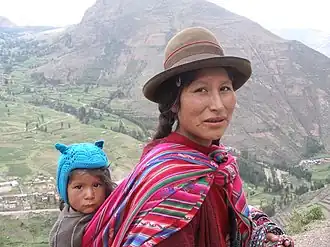
According to the 2017 Census, the Indigenous population in Peru makes up approximately 26%.[5] However, this does not include mestizos of mixed Indigenous and European descent, who make up the majority of the population. Genetic testing indicates that Peruvian Mestizos are of predominantly Indigenous ancestry.[264] Indigenous traditions and customs have shaped the way Peruvians live and see themselves today. Cultural citizenship — or what Renato Rosaldo has called, "the right to be different and to belong, in a democratic, participatory sense" (1996:243) — is not yet very well developed in Peru. This is most apparent in the country's Amazonian region, where Indigenous societies continue to struggle against state-sponsored economic abuses, cultural discrimination, and pervasive violence.[265]
Suriname
According to the 2012 census, the Indigenous population of Suriname numbers around 20,000, amounting to 3.8% of the population. The most numerous Indigenous groups in Suriname primarily comprise the Lokono, Kalina, Tiriyó, and Wayana.
Uruguay
Approximately 6.4% of the population in Uruguay is reported to have Indigenous ancestry.[17]
Venezuela

Most Venezuelans have some degree of Indigenous heritage even if they may not identify as such. The 2011 census estimated that around 52% of the population identified as mestizo. But those who identify as Indigenous, from being raised in those cultures, make up only around 2% of the total population. The Indigenous peoples speak around 29 different languages and many more dialects. As some of the ethnic groups are very small, their native languages are in danger of becoming extinct in the next decades. The most important Indigenous groups are the Ye'kuana, the Wayuu, the Kali'na, the Ya̧nomamö, the Pemon, and the Warao. The most advanced Indigenous peoples to have lived within the boundaries of present-day Venezuela are thought to have been the Timoto-cuicas, who lived in the Venezuelan Andes. Historians estimate that there were between 350,000 and 500,000 Indigenous inhabitants at the time of Spanish colonization. The most densely populated area was the Andean region (Timoto-cuicas), thanks to their advanced agricultural techniques and ability to produce a surplus of food.
The 1999 constitution of Venezuela gives Indigenous peoples special rights, although the vast majority of them still live in very critical conditions of poverty. The government provides primary education in their languages in public schools to some of the largest groups, in efforts to continue the languages.
Caribbean
The Indigenous population of the Caribbean islands consisted of the Taíno of the Lucayan Archipelago, the Greater Antilles and the northern Lesser Antilles, the Kalinago of the Lesser Antilles, the Ciguayo and Macorix of parts of Hispaniola, and the Guanahatabey of western Cuba. The overall population suffered the most adverse colonial effects out of all the Indigenous populations in the Americas, as the Kalinago have been reduced to a few islands in the Lesser Antilles such as Dominica and the Taíno are culturally extinct, though a large proportion of populations in Greater Antillean islands such as Puerto Rico and Cuba to a lesser extent,[266] possesses degrees of Taíno ancestry. The Cayman Islands were the only island group in the Caribbean to have remained unsettled by Indigenous peoples before the colonial era.[267]
Asia
Philippines
Historically, during the Spanish colonization of the Philippines, the territory was ruled as a province of the Mexico-centered Viceroyalty of New Spain and thus many Mexicans including those of Indgenous Aztec and Tlaxcalan descent, were sent as colonists there.[268]: Chpt. 6 According to a genetic study by the National Geographic, Filipinos can trace an average of 2% of their ancestry to Native Americans.[269][270]
Rise of Indigenous movements
| Part of a series on |
| Indigenous rights |
|---|
 |
| Rights |
| Governmental organizations |
| United Nations initiatives |
| International Treaties |
| NGOs and political groups |
| Issues |
| Countries |
| Category |
Since the late 20th century, Indigenous peoples in the Americas have become more politically active in asserting their treaty rights and expanding their influence. Some have organized to achieve some sort of self-determination and preservation of their cultures. Organizations such as the Coordinator of Indigenous Organizations of the Amazon River Basin and the Indian Council of South America are examples of movements that are overcoming national borders to reunite Indigenous populations, for instance, those across the Amazon Basin. Similar movements for Indigenous rights can also be seen in Canada and the United States, with movements like the International Indian Treaty Council and the accession of native Indigenous groups into the Unrepresented Nations and Peoples Organization.
There has been a recognition of Indigenous movements on an international scale. The membership of the United Nations voted to adopt the Declaration on the Rights of Indigenous Peoples, despite dissent from some of the stronger countries of the Americas.
In Colombia, various Indigenous groups have protested the denial of their rights. People organized a march in Cali in October 2008 to demand the government live up to promises to protect Indigenous lands, defend the Indigenous against violence, and reconsider the free trade pact with the United States.[271]
Indigenous heads of state
_(cropped).jpg)
The first Indigenous President of the Americas was José María Melo, of Pijao descent, who led Colombia in 1854 starting on 17 April 1854. José was born on 9 October 1800, in Chaparral, Tolima, and before his presidency, he fought alongside Simon Bolivar in the Spanish-American Wars of Independence. José María Melo led the Republic of New Granada during the Colombian Civil War of 1854 but eventually lost and was exiled on 4 December 1854.[272]
The first Indigenous candidate to be democratically elected as head of a country in the Americas was Benito Juárez, a Zapotec Mexican who was elected President of Mexico in 1858 and led the country until 1872 and led the country to victory during the Second French intervention in Mexico.[273]
In 1930 Luis Miguel Sánchez Cerro became the first Peruvian President with Indigenous Peruvian ancestry and the first in South America.[274] He came to power in a military coup.
In 2005, Evo Morales of the Aymara people was the first Indigenous candidate elected as president of Bolivia and the first elected in South America.[275]
Genetic research


Genetic history of Indigenous peoples of the Americas primarily focuses on Human Y-chromosome DNA haplogroups and Human mitochondrial DNA haplogroups. "Y-DNA" is passed solely along the patrilineal line, from father to son, while "mtDNA" is passed down the matrilineal line, from mother to offspring of both sexes. Neither recombines and thus Y-DNA and mtDNA change only by chance mutation at each generation with no intermixture between parents' genetic material.[278] Autosomal "atDNA" markers are also used but differ from mtDNA or Y-DNA in that they overlap significantly.[279] AtDNA is generally used to measure the average continent-of-ancestry genetic admixture in the entire human genome and related isolated populations.[279]
Genetic comparisons of the mitochondrial DNA (mtDNA) and Y-chromosome of Native Americans to that of certain Siberian and Central Asian peoples (specifically Paleo-Siberians, Turkic, and historically the Okunev culture) have led Russian researcher I.A. Zakharov to believe that, among all the previously studied Asian peoples, it is "the peoples living between Altai and Lake Baikal along the Sayan mountains that are genetically closest to" Indigenous Americans.[280]
Some scientific evidence links them to North Asian peoples, specifically the Indigenous peoples of Siberia, such as the Ket, Selkup, Chukchi, and Koryak peoples. Indigenous peoples of the Americas have been linked to some extent to North Asian populations by the distribution of blood types, and in genetic composition as reflected by molecular data, and limited DNA studies.[281][282][283]
The common occurrence of the Asian mtDNA haplogroups A, B, C, and D among eastern Asian and Native American populations has been noted.[284] Some subclades of C and D that have been found in the limited populations of Native Americans who have agreed to DNA testing[282][283] bear some resemblance to the C and D subclades in Mongolian, Amur, Japanese, Korean, and Ainu populations.[284][285]
Available genetic patterns lead to two main theories of genetic episodes affecting the Indigenous peoples of the Americas; first with the initial peopling of the Americas, and secondly with European colonization of the Americas.[286][287][288] The former is the determinant factor for the number of gene lineages, zygosity mutations, and founding haplotypes present in today's Indigenous peoples of the Americas populations.[287]
The most popular theory among anthropologists is the Bering Strait theory, of human settlement of the New World occurring in stages from the Bering Sea coastline, with a possible initial layover of 10,000 to 20,000 years in Beringia for the small founding population.[289][290][291] The micro-satellite diversity and distributions of the Y lineage specific to South America indicate that certain Indigenous peoples of the Americas populations have been isolated since the initial colonization of the region.[292] The Na-Dené, Inuit, and Indigenous populations of Alaska exhibit haplogroup Q (Y-DNA) mutations, however are distinct from other Indigenous peoples of the Americas with various mtDNA and atDNA mutations.[293][294][295] This suggests that the earliest migrants into the northern extremes of North America including Greenland derived from later migrant populations.[296][297]
Multiple recent findings on autosomal DNA and full genome revealed more information about the formation, settlement, and external relationships of the Indigenous peoples of the Americas to other populations. Native Americans are very closely related to the Paleosiberian tribes of Siberia, and to the ancient samples of the Mal'ta–Buret' culture (Ancient North Eurasians) as well as to the Ancient Beringians. Native Americans also share a relatively higher genetic affinity with East Asian peoples. Native American genetic ancestry is occasionally dubbed as "Amerindian". This type of ancestry largely overlaps with "Paleosiberian" ancestry but is differentiated from "Neo-Siberian" ancestry, which represents historical expansions from Northeast Asia and is today widespread among Siberian populations. The ancestors of Native Americans used a single migration route, most likely through Beringia, and subsequently populated all of the Americas in a time range between 25,000 and 15,000 years ago. Possible contact between Native Americans and Polynesians dates back to 1,400 years ago. Previously hypothesized "Paleo-Indian" groups turned out to be genetically identical to modern Native Americans. The controversial claim that the first peoples came from Europe via the North Atlantic, based on an ostensible similarity in stone-tool technology between the Solutrean culture of Pleistocene Europe and Clovis in North America, was undermined by the genome of the Anzick Clovis child, which sits squarely on the branch of Ancestral Native American peoples. No ancient or present-day genome (or mtDNA or Y chromosome marker) in the Americas has shown any direct affinities to Upper Palaeolithic European populations.[298][299][300][301][302][303][304][305]

The date for the formation of the Indigenous peoples of the Americas gene pool ranges from 36,000 to 25,000 years ago, with their internal diverging being around 21,000 years ago, during the settlement of the Americas.[307] Native Americans formed from the admixture of a lineage that diverged from Ancient East Asian people around 36,000 years ago somewhere in Southern China, and subsequently migrated northwards into Siberia where they merged with a Paleolithic Siberian population known as Ancient North Eurasians (ANE), deeply related to European hunter-gatherers, giving rise to both Indigenous peoples of Siberia and Ancestral Native Americans. Both Paleo-Siberians and Ancestral Native Americans derive between 32 and 44% of their ancestry from Ancient North Eurasians (ANE), and 56–68% ancestry from Ancient East Asians.[308][309][310][311] Based on a 2023 mitochondrial DNA study, a subsequent wave of migration from Northern China, originating near the present-day cities of Beijing and Tianjin, occurred as recently as 9000 BCE, following a previously unknown coastal route from Asia to America.[312]
Demography
The following table provides estimates for each country or territory in the Americas of the populations of Indigenous people and those with partial Indigenous ancestry, each expressed as a percentage of the overall population. The total percentage obtained by adding both of these categories is also given.
Note: these categories are inconsistently defined and measured differently from country to country. Some figures are based on the results of population-wide genetic surveys, while others are based on self-identification or observational estimation.
| Country or Territory | Indigenous | Ref. | Part Indigenous | Ref. | Combined total | Ref. |
|---|---|---|---|---|---|---|
 Greenland Greenland
|
89% | % | 89% | [313] | ||
.svg.png) Canada Canada
|
1.8% | 3.6% | 5.4% | [314] | ||
 Mexico Mexico
|
7% | 83% | 90% | [315] | ||
 United States United States
|
1.1% | >1.8% | >2.9% | [316] | ||
 Dominican Republic Dominican Republic
|
% | % | % | |||
 Grenada Grenada
|
~0.4% | ~0% | ~0.4% | [317] | ||
 Haiti Haiti
|
% | % | % | [318] | ||
 Jamaica Jamaica
|
% | % | % | |||
 Puerto Rico Puerto Rico
|
0.4% | [319] | 84% | [320][321] | 84.4% | |
 Saint Kitts and Nevis Saint Kitts and Nevis
|
% | % | % | |||
 Saint Lucia Saint Lucia
|
% | % | % | |||
 Saint Vincent and the Grenadines Saint Vincent and the Grenadines
|
2% | % | % | [322] | ||
 Trinidad and Tobago Trinidad and Tobago
|
0.1% | % | % | |||
 Argentina Argentina
|
2.83% | [323] | 27% | [324][325] | 29.38% | |
 Bolivia Bolivia
|
20% | 68% | 88% | [326] | ||
 Brazil Brazil
|
0.8% | 12% | 12.4% | [327] | ||
 Chile Chile
|
10.9% | % | % | [328] | ||
 Colombia Colombia
|
9.5% | [329] | 50.3% | [329] | 59.8% | [329] |
 Ecuador Ecuador
|
25% | 65% | 90% | [330] | ||
 French Guiana French Guiana
|
5% | % | 5% | |||
 Guyana Guyana
|
10.5% | [331] | % | % | ||
 Paraguay Paraguay
|
1.7% | 95% | 96.7% | [332] | ||
 Peru Peru
|
25.8% | 60.2% | 86% | [333] | ||
 Suriname Suriname
|
2% | [334] | % | % | ||
 Uruguay Uruguay
|
[335] | 6.4 % | [336] | 6.4 % | ||
 Venezuela Venezuela
|
2.7% | 51.6% | 54.3% | [337] | ||
 Belize Belize
|
11.3% |
Notable people
See also
- Indigenous peoples in Ecuador
- Indigenous peoples in Paraguay
- Indigenous peoples of Costa Rica
- Indigenous peoples in Argentina
- Indigenous peoples of Peru
- Indigenous peoples in Canada
- Indigenous peoples in Colombia
- Indigenous peoples in Brazil
- Indigenous peoples in Chile
- Languages of Guatemala
- Indigenous languages of the Americas
List of Indigenous peoples
- List of Greenlandic Inuit
- List of Indigenous artists of the Americas
- List of Indigenous peoples of the Americas
- List of Indigenous writers from the Americas
Culture
- Ceramics of Indigenous peoples of the Americas
- Chunkey
- Fully feathered basket
- Indian Mass
- Native American religion
- Pow wow
- Shamanism
Population and demographics
- Child development of the Indigenous peoples of the Americas
- Classification of the Indigenous peoples of the Americas
- Indigenous Movements in the Americas
- Origins of Paleoindians
- Pacific Islander
- Population history of the Indigenous peoples of the Americas
Central and South America
- Indigenous peoples of South America
- List of Mayan languages
- Society in the Spanish Colonial Americas
Caribbean
North America
References
- ^ a b "Censo de Población y Vivienda 2020: Presentación de resultados" (PDF) (in Spanish). Instituto Nacional de Estadística y Geografía. p. 49. Archived (PDF) from the original on 24 January 2022. Retrieved 11 October 2024.
Note: Indigenous population was identified as the total population in households where the head of the household, his or her spouse or any of their ascendants claimed to speak an Indigenous language
. - ^ a b "Principales resultados del Censo de Población y Vivienda 2020" (PDF) (in Spanish). Instituto Nacional de Estadística y Geografía. p. 62. Archived (PDF) from the original on 20 April 2024. Retrieved 11 October 2024. It was estimated that 19.4% of population aged 3 years and older recognize themselves as Indigenous.
- ^ "Race and Ethnicity in the United States". United States Census Bureau. 12 August 2021. Archived from the original on 15 August 2021. Retrieved 17 August 2021.
- ^ "Principales Resultados del Censo 2018" [Main Results of the 2018 Census] (PDF) (in Spanish). Instituto Nacional de Estadística. p. 10. Archived (PDF) from the original on 29 April 2021. Retrieved 29 April 2021. Sum of people who identify as Maya (6,207,503) and Xinka (264,167).
- ^ a b "Perú: Perfil Sociodemográfico" [Peru: Sociodemographic Profile] (PDF) (in Spanish). Instituto Nacional de Estadística e Informática. p. 214. Archived (PDF) from the original on 11 February 2020. Retrieved 30 April 2021. Sum of population aged 12 years and older who identify as Quechua (5,176,809), Aimara (548,292), Native or Indigenous from the Amazon (79,266), Ashaninka (55,489), Part of another Indigenous or originary peoples (49,838), Awajun (37,690) and Shipibo Konibo (25,222).
- ^ "Características de la Población – Censo 2012" [Population Characteristics – 2012 Census] (PDF) (in Spanish). Instituto Nacional de Estadística. p. 103. Archived (PDF) from the original on 30 April 2021. Retrieved 30 April 2021. Excluding Afro-Bolivians (23,330).
- ^ "Síntesis de Resultados Censo 2017" (PDF) (in Spanish). Instituto Nacional de Estadísticas. p. 16. Archived from the original (PDF) on 12 June 2024. Retrieved 30 April 2021. Excluding Rapa Nui (9,399).
- ^ "Población Indígena de Colombia" [Indigenous Population of Colombia] (PDF) (in Spanish). Departamento Administrativo Nacional de Estadística. Archived (PDF) from the original on 18 September 2020. Retrieved 1 May 2021.
- ^ "Indigenous identity by Registered or Treaty Indian status: Canada, provinces and territories, census metropolitan areas and census agglomerations with parts". Statistics Canada. 21 September 2022. Archived from the original on 27 September 2022.
- ^ "Brasil tem 1,7 milhão de indígenas e mais da metade deles vive na Amazônia Legal" (in Portuguese). Instituto Brasileiro de Geografia e Estatística. Archived from the original on 28 September 2023. Retrieved 8 October 2023.
- ^ "Censo Nacional de Población, Hogares y Viviendas 2022: Población indígena o descendiente de pueblos indígenas u originarios" (PDF) (in Spanish). Instituto Nacional de Estadística y Censos (INDEC). Archived (PDF) from the original on 12 March 2024. Retrieved 7 March 2024.
- ^ "Presentación de Resultados Nacionales" [Presentation of National Results] (PDF) (in Spanish). Instituto Nacional de Estadística y Censos. Archived (PDF) from the original on 31 October 2023. Retrieved 30 October 2023.
- ^ "Resultados Población Indígena" [Indigenous Population Results] (PDF) (in Spanish). Instituto Nacional de Estadística. Archived (PDF) from the original on 23 November 2018. Retrieved 1 May 2021.
- ^ "Población indígena en la República, por sexo, según provincia, comarca indígena, grupo indígena al que pertenece y grupos de edad: Censo 2023" [Indigenous population in the Republic, by sex, by province, Indigenous region, Indigenous group to which it belongs and age groups: 2023 Census] (PDF) (in Spanish). Instituto Nacional de Estadística y Censo. Archived (PDF) from the original on 14 June 2024. Retrieved 14 June 2024.
- ^ "Población total por grupo poblacional al que pertenece, según total nacional, departamento, área, sexo y grupo de edad" [Total population by population group to which it belongs, according to national total, department, area, sex and age group] (XLSX) (in Spanish). Instituto Nacional de Estadística. Archived from the original on 2 May 2021. Retrieved 2 May 2021. Sum of people who identify as Maya-Chortí (33,256), Lenca (453,672), Misquito (80,007), Nahua (6,339), Pech (6,024), Tolupán (19,033) and Tawahka (2,690).
- ^ "Resultados – Censo de Poblacion y Vivienda 2005" [Results – Population and Housing Census 2005] (PDF) (in Spanish). Instituto Nacional de Estadísticas y Censos. p. 184. Archived (PDF) from the original on 3 May 2021. Retrieved 1 May 2021.
- ^ a b "Población por sexo y principal ascendencia étnico racial, según departamento" (XLS). Instituto Nacional de Estadística. Archived from the original on 19 January 2022. Retrieved 5 March 2025.
- ^ "Primeros Resultados Finales del IV Censo Nacional de Población y Viviendas para Pueblos Indígenas 2022" [First Final Results of the IV National Census of Population and Housing for Indigenous Peoples 2022] (PDF) (in Spanish). Instituto Nacional de Estadística. p. 22. Archived (PDF) from the original on 16 June 2024. Retrieved 16 June 2024.
- ^ "Población indígena por pertenencia a un pueblo indígena, según provincia y sexo" [Indigenous population by belonging to an iIdigenous people, according to province and sex]. Instituto Nacional de Estadística y Censos. Archived from the original (XLS) on 17 August 2021. Retrieved 2 May 2021.
- ^ "Final 2012 Census Compendium 2" (PDF). Bureau of Statistics. p. 5. Archived (PDF) from the original on 5 January 2021. Retrieved 2 May 2021.
- ^ a b Crece el número de salvadoreños que se reconocen indígenas y afrodescendientes: Censo 2024
- ^ "Greenland in Figures 2020" (PDF). Statistics Greenland. p. 37. Archived (PDF) from the original on 3 May 2021. Retrieved 3 May 2021. Corresponding to "Born in Greenland".
- ^ "Population and Housing Census 2010" (PDF). Statistical Institute of Belize. p. 20. Archived (PDF) from the original on 5 January 2022. Retrieved 2 May 2021.
- ^ "Demografische en Sociale Karakteristieken en Migratie" (PDF) (in Dutch). Algemeen Bureau voor de Statistiek. p. 46. Archived (PDF) from the original on 3 May 2021. Retrieved 2 May 2021.
- ^ "Puerto Rico: 2010 Summary Population and Housing Characteristics" (PDF). U.S. Census Bureau. p. 90. Archived (PDF) from the original on 31 January 2022. Retrieved 30 January 2022.
- ^ Aupetit, Mathilde. "Les populations indigènes de la Guyane française : une mémoire environnementale essentielle à protéger" (in French). Archived from the original on 3 May 2021. Retrieved 3 May 2021.
- ^ "Population and Housing Census Report 2012" (PDF). Statistical Office. p. 28. Archived (PDF) from the original on 24 January 2022. Retrieved 30 January 2022.
- ^ "Ethnic Groups by Sex 1991, 2001 and 2011". Central Statistics Office of Dominica. Archived from the original on 30 January 2022. Retrieved 30 January 2022.
- ^ "2011 Population and Housing Census Demographic Report" (PDF). Central Statistical Office. p. 94. Archived (PDF) from the original on 30 December 2021. Retrieved 2 May 2021.
- ^ "2010 Housing and Population Census". The Central Statistical Office of Saint Lucia. Archived from the original on 29 March 2023. Retrieved 12 October 2023. To generate the report follow Population and Housing > Basic Characteristics > Person Variables, select Ethnic group and execute.
- ^ "2011 Population and Housing Census" (PDF). Statistics Division. p. 64. Archived (PDF) from the original on 11 June 2020. Retrieved 10 October 2023.
- ^ "Population and Housing Census 2011" (PDF). Central Statistics Office. Archived (PDF) from the original on 28 September 2021. Retrieved 30 May 2021.
- ^ "Population by Ethnic, Racial or National Group, 2011". Department of Statistics, Ministry of Sustainable Development. Archived from the original on 11 June 2023. Retrieved 29 March 2024.
- ^ Hultkrantz 1987.
- ^ Zerries 1987.
- ^ a b "People and Society: Peru". The World Factbook. Central Intelligence Agency. Archived from the original on 19 November 2021. Retrieved 28 December 2011.
- ^ "Bolivia: People and Society". The World Factbook. CIA. Archived from the original on 27 September 2021. Retrieved 14 July 2025.
- ^ "Guatemala: People and Society". The World Factbook. CIA. Archived from the original on 16 April 2021. Retrieved 14 July 2025.
- ^ Marez, Curtis (2007). "Mestizo/a". In Burgett, Bruce; Hendler, Glenn (eds.). Keywords for American Cultural Studies (3rd ed.). NYU Press. Archived from the original on 22 May 2024. Retrieved 29 June 2024.
- ^ Mangan, Jane E. (30 June 2014). "Mestizos". Atlantic History. doi:10.1093/obo/9780199730414-0240. Archived from the original on 6 August 2023. Retrieved 29 June 2024.
- ^ Lizcano Fernández, Francisco (2004). "Las etnias centroamericanas en la segunda mitad del siglo XX" [Central American ethnic groups in the second half of the 20th century] (PDF). Revista Mexicana del Caribe (in Spanish). IX (17). Archived from the original (PDF) on 9 April 2024. Retrieved 4 May 2011.
- ^ Lizcano Fernández, Francisco (August 2008). "Composición Étnica de las Tres Áreas Culturales del Continente Americano al Comienzo del Siglo XXI" [Ethnic Composition of the Three Cultural Areas of the American Continent at the Beginning of the 21st Century]. Convergencia (in Spanish). 12 (38): 185–232. ISSN 1405-1435. Archived from the original on 14 September 2024. Retrieved 29 June 2024.
- ^ De Oliveira, Thais C.; Secolin, Rodrigo; Lopes-Cendes, Iscia (19 January 2023). "A review of ancestrality and admixture in Latin America and the Caribbean focusing on native American and African descendant populations". Frontiers in Genetics. 14 1091269. doi:10.3389/fgene.2023.1091269. ISSN 1664-8021. PMC 9893294. PMID 36741309.
- ^ Bartolomé (1996:2)
- ^ "Varieties of Indigeneity in the Americas" (PDF). Stanford University. 2018. Archived from the original (PDF) on 1 July 2024.
- ^ Graeber, David; Wengrow, David (2001). The Dawn of Everything, A New History of Humanity. New York: Farrar, Straus & Giroux. pp. 346–358.
- ^ Wilton, David (2 December 2004). Word Myths: debunking linguistic urban legends. Oxford University Press. p. 163. ISBN 978-0-19-517284-3. Retrieved 3 July 2011.
- ^ Adams, Cecil (25 October 2001). "Does "Indian" derive from Columbus's description of Native Americans as "una gente in Dios"?". The Straight Dope. Archived from the original on 28 June 2011. Retrieved 3 July 2011.
- ^ Zimmer, Ben (12 October 2009). "The Biggest Misnomer of All Time?". VisualThesaurus. Archived from the original on 19 April 2012. Retrieved 3 July 2011.
- ^ Hoxie, Frederick E. (1996). Encyclopedia of North American Indians. Houghton Mifflin Harcourt. p. 568. ISBN 978-0-395-66921-1.
- ^ Herbst, Philip (1997). The Color of Words: An Encyclopaedic Dictionary of Ethnic Bias in the United States. Intercultural Press. p. 116. ISBN 978-1-877864-97-1.
- ^ Gómez-Moriana, Antonio (12 May 1993). "The Emerging of a Discursive Instance: Columbus and the invention of the "Indian"". Discourse Analysis as Sociocriticism: The Spanish Golden Age. University of Minnesota Press. pp. 124–132. ISBN 978-0-8166-2073-9. Retrieved 4 July 2011.
- ^ Grey, CGP (24 November 2019). 'Indian' or 'Native American'? [Reservations, Part 0] (YouTube video). Archived from the original on 21 December 2021. Retrieved 13 August 2022.
- ^ Sutton, M.Q. (2021). An Introduction to Native North America. Taylor & Francis. p. 30. ISBN 978-1-000-34916-0. Archived from the original on 8 July 2023. Retrieved 5 July 2023.
- ^ "Americanists in dispute" (PDF). The New York Times. 22 October 1902. Archived (PDF) from the original on 25 February 2021. Retrieved 14 January 2009.
- ^ "Terminology". Survival International. Archived from the original on 9 December 2012. Retrieved 30 March 2012.. "Aborigen" Archived 15 December 2022 at the Wayback Machine Diccionario de la Real Academia Española. Retrieved 8 February 2012.
- ^ Reid, Basil. "Tracing Our Amerindian Heritage". www2.sta.uwi.edu. Archived from the original on 16 February 2016. Retrieved 10 February 2016.
- ^ "The Abbreviated History of Barbados". www.barbados.org. Archived from the original on 16 January 2000. Retrieved 10 February 2016.
- ^ Unique Media Design Limited. "diGJamaica :: Amerindian Jamaica". diGJamaica.com. Archived from the original on 23 February 2016. Retrieved 10 February 2016.
- ^ McKay, Celeste (April 2015). "Briefing Note on Terminology". University of Manitoba. Archived from the original on 25 October 2016. Retrieved 2 July 2020.
- ^ Joseph, Bob (21 September 2016). "Indigenous or Aboriginal: Which is correct?". CBC News. Archived from the original on 22 September 2016. Retrieved 28 September 2022.
- ^ "Terminology". Indian and Northern Affairs Canada. Archived from the original on 27 October 2009. Retrieved 11 November 2009.
The Canadian Constitution recognizes three groups of Aboriginal people – Indians (First Nations), Métis and Inuit. These separate peoples have unique heritages, languages, cultural practices, and spiritual beliefs
- ^ a b c Kesler, Linc (10 February 2020). "Aboriginal Identity & Terminology". Indigenous Foundations. Archived from the original on 24 March 2022. Retrieved 23 March 2022.
- ^ a b "Indigenous Terminology Guide". Queen's University. 2019. Archived from the original on 24 March 2022. Retrieved 23 March 2022.
- ^ "Terminology of First Nations Native, Aboriginal and Indian" (PDF). the Office of the Aboriginal Advisor for Aboriginals. Archived from the original (PDF) on 14 July 2010. Retrieved 11 November 2009.
Native is a word similar in meaning to Aboriginal. Native Peoples or First peoples is a collective term to describe the descendants of the original peoples of North America.
- ^ a b Mann, Charles C. (2006). 1491: New Revelations of the Americas Before Columbus. Knopf Doubleday Publishing. ISBN 978-1-4000-3205-1.
- ^ a b loprespub (20 May 2020). "Indigenous Peoples: Terminology Guide". HillNotes. Archived from the original on 20 January 2021. Retrieved 10 September 2021.
- ^ Hock, Hans Henrich; Joseph, Brian D. (22 July 2019). Language History, Language Change, and Languas Relationship. De Gruyter. ISBN 978-3-11-060969-1.
- ^ McCoy, John F.; Light, Timothy (1986). Contributions to Sino-Tibetan Studies. Brill Archive. ISBN 90-04-07850-9.
- ^ Scott, James C.; Tehranian, John; Mathias, Jeremy (2002). "The Production of Legal Identities Proper to States: The Case of the Permanent Family Surname". Comparative Studies in Society and History. 44: 4–44. doi:10.1017/S0010417502000026. ISSN 0010-4175. S2CID 146687944.
- ^ >Mann, Charles C. (2006). "Loaded Words". 1491: New Revelations of the Americas Before Columbus. Knopf Doubleday Publishing. ISBN 978-1-4000-3205-1.
- ^ "Why Capitalize "Indigenous"?". SAPIENS. 19 May 2020. Archived from the original on 25 June 2021. Retrieved 25 June 2021.
- ^ "Associated Press Stylebook". www.apstylebook.com. Archived from the original on 16 August 2021. Retrieved 25 June 2021.
- ^ "Indigenous Terminology Guide". www.queensu.ca. Queen's University. Archived from the original on 24 March 2022. Retrieved 25 June 2021.
- ^ "University Of Guelph Brand Guide | Indigenous Peoples". guides.uoguelph.ca. 14 November 2019. Archived from the original on 25 June 2021. Retrieved 25 June 2021.
- ^ Burenhult, Göran (2000). Die ersten Menschen. Weltbild Verlag. ISBN 978-3-8289-0741-6.
- ^ Pringle, Heather (8 March 2017). "What Happens When an Archaeologist Challenges Mainstream Scientific Thinking?". Smithsonian.
- ^ Fagan, Brian M. & Durrani, Nadia (2016). World Prehistory: A Brief Introduction. Routledge. p. 124. ISBN 978-1-317-34244-1.
- ^ a b Goebel, Ted; Waters, Michael R.; O'Rourke, Dennis H. (2008). "The Late Pleistocene dispersal of modern humans in the Americas" (PDF). Science. 319 (5869): 1497–1502. Bibcode:2008Sci...319.1497G. CiteSeerX 10.1.1.398.9315. doi:10.1126/science.1153569. PMID 18339930. S2CID 36149744. Archived from the original (PDF) on 2 January 2014. Retrieved 5 February 2010.
- ^ Zimmer, Carl (3 January 2018). "In the Bones of a Buried Child, Signs of a Massive Human Migration to the Americas". The New York Times. Retrieved 3 January 2018.
- ^ Moreno-Mayar, JV; Potter, BA; Vinner, L; et al. (2018). "Terminal Pleistocene Alaskan genome reveals first founding population of Native Americans" (PDF). Nature. 553 (7687): 203–207. Bibcode:2018Natur.553..203M. doi:10.1038/nature25173. PMID 29323294. S2CID 4454580.
- ^ Núñez Castillo, Mélida Inés (20 December 2021). Ancient genetic landscape of archaeological human remains from Panama, South America and Oceania described through STR genotype frequencies and mitochondrial DNA sequences. Dissertation (doctoralThesis). doi:10.53846/goediss-9012. S2CID 247052631.
- ^ Ash, Patricia J. & Robinson, David J. (2011). The Emergence of Humans: An Exploration of the Evolutionary Timeline. John Wiley & Sons. p. 289. ISBN 978-1-119-96424-7.
- ^ Roberts, Alice (2010). The Incredible Human Journey. A&C Black. pp. 101–103. ISBN 978-1-4088-1091-0.
- ^ Fitzhugh, Drs. William; Goddard, Ives; Ousley, Steve; Owsley, Doug; Stanford, Dennis. "Paleoamerican". Smithsonian Institution Anthropology Outreach Office. Archived from the original on 5 January 2009. Retrieved 15 January 2009.
- ^ "Atlas of the Human Journey-The Genographic Project". National Geographic Society. 1996–2008. Archived from the original on 1 May 2011. Retrieved 27 January 2017.
- ^ "The peopling of the Americas: Genetic ancestry influences health". Scientific American. Retrieved 8 May 2019.
- ^ Fladmark, K. R. (1979). "Alternate Migration Corridors for Early Man in North America". American Antiquity. 44 (1): 55–69. doi:10.2307/279189. JSTOR 279189. S2CID 162243347.
- ^ "68 Responses to "Sea will rise 'to levels of last Ice Age'"". Center for Climate Systems Research, Columbia University. 26 January 2009. Retrieved 17 November 2009.
- ^ a b Null (27 June 2022). "Peopling of the Americas". Proceedings of the National Academy of Sciences of the United States of America. Retrieved 19 December 2022.
- ^ Waguespack, Nicole (2012). "Early Paleoindians, from Colonization to Folsom". In Timothy R. Pauketat (ed.). The Oxford Handbook of North American Archaeology. Oxford University Press. pp. 86–95. ISBN 978-0-19-538011-8.
- ^ Surovell, T. A.; Allaun, S. A.; Gingerich, J. A. M.; Graf, K. E.; Holmes, C. D. (2022). "Late Date of human arrival to North America". PLOS ONE. 17 (4): e0264092. doi:10.1371/journal.pone.0264092. PMC 9020715. PMID 35442993.
- ^ a b c Yasinski, Emma (2 May 2022). "New Evidence Complicates the Story of the Peopling of the Americas". The Scientist Magazine. Retrieved 19 December 2022.
- ^ Ardelean, Ciprian F.; Becerra-Valdivia, Lorena; Pedersen, Mikkel Winther; Schwenninger, Jean-Luc; Oviatt, Charles G.; Macías-Quintero, Juan I.; Arroyo-Cabrales, Joaquin; Sikora, Martin; Ocampo-Díaz, Yam Zul E.; Rubio-Cisneros, Igor I.; Watling, Jennifer G.; De Medeiros, Vanda B.; De Oliveira, Paulo E.; Barba-Pingarón, Luis; Ortiz-Butrón, Agustín; Blancas-Vázquez, Jorge; Rivera-González, Irán; Solís-Rosales, Corina; Rodríguez-Ceja, María; Gandy, Devlin A.; Navarro-Gutierrez, Zamara; de la Rosa-Díaz, Jesús J.; Huerta-Arellano, Vladimir; Marroquín-Fernández, Marco B.; Martínez-Riojas, L. Martin; López-Jiménez, Alejandro; Higham, Thomas; Willerslev, Eske (2020). "Evidence of human occupation in Mexico around the Last Glacial Maximum". Nature. 584 (7819): 87–92. Bibcode:2020Natur.584...87A. doi:10.1038/s41586-020-2509-0. PMID 32699412. S2CID 220697089.
- ^ Becerra-Valdivia, Lorena; Higham, Thomas (2020). "The timing and effect of the earliest human arrivals in North America". Nature. 584 (7819): 93–97. Bibcode:2020Natur.584...93B. doi:10.1038/s41586-020-2491-6. PMID 32699413. S2CID 220715918.
- ^ Gruhn, Ruth (22 July 2020). "Evidence grows that peopling of the Americas began more than 20,000 years ago". Nature. 584 (7819): 47–48. Bibcode:2020Natur.584...47G. doi:10.1038/d41586-020-02137-3. PMID 32699366. S2CID 220717778.
- ^ Spencer Wells (2006). Deep Ancestry: Inside the Genographic Project. National Geographic Books. pp. 222–. ISBN 978-0-7922-6215-2. OCLC 1031966951.
- ^ John H. Relethford (17 January 2017). 50 Great Myths of Human Evolution: Understanding Misconceptions about Our Origins. John Wiley & Sons. pp. 192–. ISBN 978-0-470-67391-1. OCLC 1238190784.
- ^ H. James Birx, ed. (10 June 2010). 21st Century Anthropology: A Reference Handbook. SAGE Publications. ISBN 978-1-4522-6630-5. OCLC 1102541304.
- ^ John E Kicza; Rebecca Horn (3 November 2016). Resilient Cultures: America's Native Peoples Confront European Colonialization 1500-1800 (2 ed.). Routledge. ISBN 978-1-315-50987-7.
- ^ Baisas, Laura (16 November 2022). "Scientists still are figuring out how to age the ancient footprints in White Sands National Park". Popular Science. Retrieved 18 September 2023.
- ^ Somerville, Andrew D.; Casar, Isabel; Arroyo-Cabrales, Joaquín (2021). "New AMS Radiocarbon Ages from the Preceramic Levels of Coxcatlan Cave, Puebla, Mexico: A Pleistocene Occupation of the Tehuacan Valley?". Latin American Antiquity. 32 (3): 612–626. doi:10.1017/laq.2021.26.
- ^ Chatters, James C.; Potter, Ben A.; Prentiss, Anna Marie; Fiedel, Stuart J.; Haynes, Gary; Kelly, Robert L.; Kilby, J. David; Lanoë, François; Holland-Lulewicz, Jacob; Miller, D. Shane; Morrow, Juliet E.; Perri, Angela R.; Rademaker, Kurt M.; Reuther, Joshua D.; Ritchison, Brandon T.; Sanchez, Guadalupe; Sánchez-Morales, Ismael; Spivey-Faulkner, S. Margaret; Tune, Jesse W.; Haynes, C. Vance (23 October 2021). "Evaluating Claims of Early Human Occupation at Chiquihuite Cave, Mexico". PaleoAmerica. 8 (1). Informa UK Limited: 1–16. doi:10.1080/20555563.2021.1940441. ISSN 2055-5563. S2CID 239853925.
- ^ Bryant, Vaughn M. Jr. (1998). "Pre-Clovis". In Guy Gibbon; et al. (eds.). Archaeology of Prehistoric Native America: An Encyclopedia. Garland reference library of the humanities. Vol. 1537. pp. 682–683. ISBN 978-0-8153-0725-9.
- ^ Hunt, Katie (5 October 2023). "Scientists say they've confirmed evidence that humans arrived in the Americas far earlier than previously thought". CNN. Retrieved 22 July 2024.
- ^ Fernández-Armesto, Felipe (1987). Before Columbus: Exploration and Colonisation from the Mediterranean to the Atlantic: 1229–1492. New studies in medieval history series. Basingstoke, Hampshire: Macmillan Education. ISBN 978-0-333-40382-2. OCLC 20055667.
- ^ "Method and Theory in American Archaeology". Gordon Willey and Philip Phillips. University of Chicago. 1958. Archived from the original on 23 January 2004.
- ^ Shady Solis, Ruth; Jonathan Haas; Winifred Creamer (27 April 2001). "Dating Caral, a Preceramic Site in the Supe Valley on the Central Coast of Peru". Science. 292 (5517): 723–726. Bibcode:2001Sci...292..723S. doi:10.1126/science.1059519. PMID 11326098. S2CID 10172918.
- ^ Haas, Jonathan; Creamer, Winifred; Ruiz, Alvaro (23 December 2004). "Dating the Late Archaic occupation of the Norte Chico region in Peru". Nature. 432 (7020): 1020–1023. Bibcode:2004Natur.432.1020H. doi:10.1038/nature03146. PMID 15616561. S2CID 4426545.
- ^ Wright, Ronald (2005). Stolen Continents: 500 Years of Conquest and Resistance in the Americas (1st Mariner Books ed.). Boston, Massachusetts: Houghton Mifflin. ISBN 978-0-618-49240-4. OCLC 57511483.
- ^ Drake, Thomas. "1519". English 257: Literature of Western Civilization. University of Idaho. Archived from the original on 27 December 2018. Retrieved 26 December 2018.
- ^ Bucholz, Robert. "Europe in 1500". University of Hawaii. Archived from the original on 25 December 2018. Retrieved 26 December 2018.
- ^ Munro, John. "Medieval Population Dynamics to 1500" (PDF). University of Toronto. Archived (PDF) from the original on 26 December 2018. Retrieved 26 December 2018.
- ^ Erdoes, Richard; Ortiz, Alfonso (1985). American%20Indian%20Myths%20and%20Legends&pg=PP1 American Indian Myths and Legends. New York: Pantheon Books. p. xiv. ISBN 9780804151757.
- ^ Taylor, Alan (2002). American colonies; Volume 1 of The Penguin history of the United States, History of the United States Series. Penguin. p. 40. ISBN 978-0142002100. Retrieved 7 October 2013.
- ^ Stannard, David E. (1993). American Holocaust: The Conquest of the New World. Oxford University Press. p. 151. ISBN 978-0-19-508557-0.
- ^ a b McKenna, Erin; Pratt, Scott L. (2015). American Philosophy: From Wounded Knee to the Present. London: Bloomsbury. p. 375. ISBN 978-1-44118-375-0.
- ^ Denevan, William M. (15 March 1992). The Native Population of the Americas in 1492. Madison, Wis: Univ of Wisconsin Press. ISBN 978-0-299-13434-1.
- ^ a b c d Curtin, Philip D. (1993). "Disease Exchange Across the Tropical Atlantic". History and Philosophy of the Life Sciences. 15 (3): 329–356. JSTOR 23331729. PMID 7529931.
- ^ Martin, Stacie E (2004). "Native Americans". In Shelton, Dinah (ed.). Encyclopedia of Genocide and Crimes against Humanity. Macmillan Library Reference. pp. 740–746.
- ^ Stannard, David E. (1993). American Holocaust:The Conquest of the New World: The Conquest of the New World. Oxford University Press, USA. ISBN 978-0-19-508557-0.
- ^ Thornton, Russel (1987). American Indian Holocaust and Survival: ˜a Population History Since 1492. Norman, Oklahoma: University of Oklahoma Press. ISBN 978-0-8061-2074-4.
- ^ Thornton, Russell (1990). American Indian Holocaust and Survival: A Population History since 1492. University of Oklahoma Press. p. 48. ISBN 978-0-8061-2220-5.
- ^ a b Espagnols-Indiens: le choc des civilisations" in L'Histoire, n°322, July–August 2007, pp.14–21
- ^ Smallpox Through History. Archived from the original on 29 October 2009.
- ^ Rodriguez, Junius P. (2007). Encyclopedia of slave resistance and rebellion, Volume 1. Greenwood Publishing. ISBN 978-0-313-33272-2. Retrieved 1 July 2010.
- ^ Traboulay, David M. (September 1994). Columbus and Las Casas: the conquest and Christianization of America, 1492–1566. University Press of America. ISBN 978-0-8191-9642-2. Retrieved 1 July 2010.
- ^ "Laws of Burgos, 1512–1513". Faculty.smu.edu. Archived from the original on 6 June 2019. Retrieved 23 May 2010.
- ^ Cook, Noble David (1998). Born to Die: Disease and New World Conquest, 1492–1650. Cambridge University Press. p. 1. ISBN 978-0-521-62208-0.
- ^ "BBC Smallpox: Eradicating the Scourge". BBC. 5 November 2009. Archived from the original on 7 May 2013. Retrieved 23 May 2010.
- ^ "The Story Of... Smallpox – and other Deadly Eurasian Germs". PBS. Archived from the original on 16 January 2010. Retrieved 23 May 2010.
- ^ Kohn, George C. (2008). Encyclopedia of plague and pestilence: from ancient times to the present. Infobase Publishing. p. 160. ISBN 978-0-8160-6935-4.
- ^ "Africans in bondage: studies in slavery and the slave trade : essays in honor of Philip D. Curtin on the occasion of the twenty-fifth anniversary of African Studies at the University of Wisconsin: Chapter 1: When did smallpox reach the New World (and why does it matter)?". digicoll.library.wisc.edu. Archived from the original on 6 December 2017. Retrieved 5 December 2017.
- ^ "Epidemics". Libby-genealogy.com. 30 April 2009. Archived from the original on 22 July 2013. Retrieved 23 May 2010.
- ^ "American plague". New Scientist. Archived from the original on 15 December 2022.
- ^ "Allempires.info". 17 November 2017. Archived from the original on 17 November 2017.
- ^ "Stacy Goodling, "Effects of European Diseases on the Inhabitants of the New World"". Millersville.edu. Archived from the original on 10 May 2008. Retrieved 23 May 2010.
- ^ See Varese (2004), as reviewed in Dean (2006).
- ^ "Aboriginal Distributions 1630 to 1653". Natural Resources Canada.
- ^ Koplow, David A. "Smallpox: The Fight to Eradicate a Global Scourge". Ucpress.edu. p. 9. Archived from the original on 7 September 2008. Retrieved 23 February 2011.
- ^ "Dutch Children's Disease Kills Thousands of Mohawks". Archived from the original on 17 December 2007.
- ^ Spaulding, W. B. "Smallpox". The Canadian Encyclopedia. Archived from the original on 8 June 2019. Retrieved 18 August 2019.
- ^ "Iroquois". Fourdir.com. Archived from the original on 6 November 2016. Retrieved 23 May 2010.
- ^ Lange, Greg (23 January 2003). "Smallpox epidemic ravages Native Americans on the northwest coast of North America in the 1770s". Historylink.org. Archived from the original on 26 May 2008. Retrieved 23 May 2010.
- ^ Houston, C. S.; Houston, S (2000). "The first smallpox epidemic on the Canadian Plains: In the fur-traders' words". The Canadian Journal of Infectious Diseases. 11 (2): 112–115. doi:10.1155/2000/782978. PMC 2094753. PMID 18159275.
- ^ "Mountain Man Plain Indian Fur Trade". Thefurtrapper.com. Archived from the original on 17 March 2011. Retrieved 23 May 2010.
- ^ Pearson, J. Diane (Autumn 2003). "The Politics of Sovereignty". Wíčazo Ša Review. 18 (2): 9–35. doi:10.1353/wic.2003.0017. JSTOR 1409535. S2CID 154875430.
- ^ Fineberg, Gail. "500 Years of Brazil's Discovery". Library of Congress. Archived from the original on 5 December 2009. Retrieved 23 May 2010.
- ^ "Brazil urged to protect Indians". BBC News. 30 March 2005. Archived from the original on 17 November 2017. Retrieved 23 May 2010.
- ^ "Ancient Horse (Equus cf. E. complicatus)". The Academy of Natural Sciences, Thomas Jefferson Fossil Collection, Philadelphia. Archived from the original on 29 August 2008.
- ^ a b c d e f g h i Gone, Joseph P., William E. Hartmann, Andrew Pomerville, Dennis C. Wendt, Sarah H. Klem, and Rachel L. Burrage. 2019. "The impact of historical trauma on health outcomes for Indigenous populations in the USA and Canada: A systematic review Archived 15 December 2022 at the Wayback Machine." American Psychologist 74(1):20–35. doi:10.1037/amp0000338.
- ^ Les Whitbeck, B; Chen, Xiaojin; Hoyt, Dan R; Adams, Gary W (1 July 2004). "Discrimination, historical loss and enculturation: culturally specific risk and resiliency factors for alcohol abuse among American Indians". Journal of Studies on Alcohol. 65 (4): 409–418. doi:10.15288/jsa.2004.65.409. ISSN 0096-882X. PMID 15376814.
- ^ a b Anastario, Michael P.; FourStar, Kris; Rink, Elizabeth (1 October 2013). "Sexual Risk Behavior and Symptoms of Historical Loss in American Indian Men". Journal of Community Health. 38 (5): 894–899. doi:10.1007/s10900-013-9695-8. ISSN 1573-3610. PMID 23624772. S2CID 7866571.
- ^ a b Clark, Julie Dorton; Winterowd, Carrie (2012). "Correlates and Predictors of Binge Eating Among Native American Women". Journal of Multicultural Counseling and Development. 40 (2): 117–127. doi:10.1002/j.2161-1912.2012.00011.x. ISSN 2161-1912.
- ^ a b Tucker, Raymond P.; Wingate, LaRicka R.; O'Keefe, Victoria M. (2016). "Historical loss thinking and symptoms of depression are influenced by ethnic experience in American Indian college students". Cultural Diversity and Ethnic Minority Psychology. 22 (3): 350–358. doi:10.1037/cdp0000055. PMID 26371791.
- ^ Bombay, Amy; Matheson, Kimberly; Anisman, Hymie (24 September 2013). "The intergenerational effects of Indian Residential Schools: Implications for the concept of historical trauma". Transcultural Psychiatry. 51 (3): 320–338. doi:10.1177/1363461513503380. ISSN 1363-4615. PMC 4232330. PMID 24065606.
- ^ Elias, Brenda; Mignone, Javier; Hall, Madelyn; Hong, Say P.; Hart, Lyna; Sareen, Jitender (1 May 2012). "Trauma and suicide behaviour histories among a Canadian indigenous population: An empirical exploration of the potential role of Canada's residential school system". Social Science & Medicine. 74 (10): 1560–1569. doi:10.1016/j.socscimed.2012.01.026. ISSN 0277-9536. PMID 22464223. Archived from the original on 13 October 2012. Retrieved 10 August 2020.
- ^ For the Cedar Project Partnership; Pearce, Margo E.; Christian, Wayne M.; Patterson, Katharina; Norris, Kat; Moniruzzaman, Akm; Craib, Kevin J. P.; Schechter, Martin T.; Spittal, Patricia M. (1 June 2008). "The Cedar Project: Historical trauma, sexual abuse and HIV risk among young Aboriginal people who use injection and non-injection drugs in two Canadian cities". Social Science & Medicine. 66 (11): 2185–2194. doi:10.1016/j.socscimed.2008.03.034. ISSN 0277-9536. PMC 5125817. PMID 18455054.
- ^ Armenta, Brian E.; Whitbeck, Les B.; Habecker, Patrick N. (January 2016). "The Historical Loss Scale: Longitudinal Measurement Equivalence and Prospective Links to Anxiety Among North American Indigenous Adolescents". Cultural Diversity & Ethnic Minority Psychology. 22 (1): 1–10. doi:10.1037/cdp0000049. ISSN 1099-9809. PMC 6038142. PMID 26213891.
- ^ Ehlers, Cindy L.; Gizer, Ian R.; Gilder, David A.; Ellingson, Jarrod M.; Yehuda, Rachel (1 November 2013). "Measuring historical trauma in an American Indian community sample: Contributions of substance dependence, affective disorder, conduct disorder and PTSD". Drug and Alcohol Dependence. 133 (1): 180–187. doi:10.1016/j.drugalcdep.2013.05.011. ISSN 0376-8716. PMC 3810370. PMID 23791028.
- ^ ""Native Americans: The First Farmers." AgExporter October 1, 1999". Allbusiness.com. Archived from the original on 29 August 2011. Retrieved 23 May 2010.
- ^ Spooner, DM; et al. (2005). "A single domestication for potato based on multilocus amplified fragment length polymorphism genotyping". PNAS. 102 (41): 14694–99. Bibcode:2005PNAS..10214694S. doi:10.1073/pnas.0507400102. PMC 1253605. PMID 16203994. Lay summary Archived 26 April 2011 at the Wayback Machine
- ^ Miller, N (29 January 2008). "Using DNA, scientists hunt for the roots of the modern potato". American Association for the Advancement of Science. Archived from the original on 26 February 2020. Retrieved 10 September 2008.
- ^ Solis, JS; Anabalón Rodríguez; Leonardo; et al. (2007). "Molecular description and similarity relationships among native germplasm potatoes (Solanum tuberosum ssp. tuberosum L.) using morphological data and AFLP markers". Electronic Journal of Biotechnology. 10 (3): 376–385. doi:10.2225/vol10-issue3-fulltext-14 (inactive 12 July 2025). hdl:10925/320. Archived from the original on 9 February 2009. Retrieved 19 November 2009.
{{cite journal}}: CS1 maint: DOI inactive as of July 2025 (link) - ^ Francis, John Michael (2005). Iberia and the Americas. ABC-CLIO. ISBN 978-1-85109-421-9.
- ^ Newson, Linda (2001). "6: Pathogens, Places and Peoples: Geographical Variations in the Impact of Disease in Early Spanish America and the Philippines". In Raudzens, George (ed.). Technology, Disease, and Colonial Conquests, Sixteenth to Eighteenth Centuries: Essays Reappraising the Guns and Germs Theories. History of warfare. Vol. 2 (reprint ed.). Boston: Brill Academic Publishers (published 2003). p. 190. ISBN 9780391042063. Retrieved 27 October 2018.
It is clear that in pre-Columbian times some groups struggled to survive and often suffered food shortages and famines, while others enjoyed a varied and substantial diet.
- ^ Gill, Richardson Benedict (2000). "5. Famine and Social Dissolution". The Great Maya Droughts: Water, Life, and Death (revised ed.). Albuquerque: University of New Mexico Press (published 2001). p. 123. ISBN 9780826327741. Retrieved 27 October 2018.
In Tenochtitlan, during the famine of 1 Rabbit in 1454, Moctezuma Ilhuicamina distributed food from the royal granaries to the poor. When the stores ran out, he gave permission for the populace to leave the city to find food elsewhere and people left. The populations of Texcoco, Chalco, Xochimilco, and Tepanecapan also fled their cities. The Maya Lowlands appear to have suffered a famine at the same time, and the cities of Chichen Itza, Mayapan, and Uxmal appear to have been all abandoned simultaneously [...].
- ^ Owen, Wayne (2002). "Chapter 2 (TERRA–2): The History of Native Plant Communities in the South". Southern Forest Resource Assessment Final Report. U.S. Department of Agriculture, Forest Service, Southern Research Station. Archived from the original on 15 May 2008. Retrieved 29 July 2008.
- ^ Lentz, David L., ed. (2000). Imperfect balance: landscape transformations in the Precolumbian Americas. New York: Columbia University Press. pp. 241–242. ISBN 978-0-231-11157-7.
- ^ Michael Pollan, The Omnivore's Dilemma
- ^ Atran, Scott; Medin, Douglas (2010). The Native Mind and the Cultural Construction of Nature. MIT Press.
- ^ Ní Leathlobhair, Máire; Perri, Angela R; Irving-Pease, Evan K; Witt, Kelsey E; Linderholm, Anna; Haile, James; Lebrasseur, Ophelie; Ameen, Carly; Blick, Jeffrey; Boyko, Adam R; Brace, Selina; Cortes, Yahaira Nunes; Crockford, Susan J; Devault, Alison; Dimopoulos, Evangelos A; Eldridge, Morley; Enk, Jacob; Gopalakrishnan, Shyam; Gori, Kevin; Grimes, Vaughan; Guiry, Eric; Hansen, Anders J; Hulme-Beaman, Ardern; Johnson, John; Kitchen, Andrew; Kasparov, Aleksei K; Kwon, Young-Mi; Nikolskiy, Pavel A; Lope, Carlos Peraza; et al. (2018). "The evolutionary history of dogs in the Americas" (PDF). Science. 361 (6397): 81–85. Bibcode:2018Sci...361...81N. doi:10.1126/science.aao4776. PMC 7116273. PMID 29976825. Archived (PDF) from the original on 1 June 2023. Retrieved 7 September 2023.
- ^ Petrigh, Romina S.; Fugassa, Martin H. (13 December 2013). "Molecular identification of a Fuegian dog belonging to the Fagnano Regional Museum ethnographic collection, Tierra del Fuego" (PDF). Quaternary International. 317: 14–18. Bibcode:2013QuInt.317...14P. doi:10.1016/j.quaint.2013.07.030. hdl:11336/25319. Archived from the original (PDF) on 20 December 2016. Retrieved 2 September 2020.
- ^ Orquera, L.; Piana, E. (1999). La vida material y social de los Yámana [The material and social life of the Yámana] (in Spanish). Buenos Aires: Editorial Eudeba. pp. 178–180.
- ^ Di Peso, Charles (1974). Casas Grandes: A Fallen Trading Center of the Gran Chichimeca (Vols. 13). Flagstaff, AZ: Northland Press.
- ^ Di Peso, Charles (1974). Casas Grandes: A Fallen Trading Center of the Gran Chichimeca (Vols. 1–3). Flagstaff, AZ: Northland Press.
- ^ Kent, Robert B. (1984). "Mesoamerican Stingless Beekeeping". Journal of Cultural Geography. 4 (2): 14–28. doi:10.1080/08873638409478571. ISSN 0887-3631. Archived from the original on 19 January 2022. Retrieved 29 March 2021.
- ^ Phipps, Elena (2010). Cochineal Red: The Art History of a Color. New York, NY: Metropolitan Museum of Art. p. 10. ISBN 978-1-58839-361-6. Archived from the original on 28 March 2022. Retrieved 28 March 2022.
- ^ Pearlstein, Ellen; MacKenzie, Mark; Kaplan, Emily; Howe, Ellen; Levinson, Judith (2015). "Tradition and Innovation, Cochineal and Andean keros". In Anderson, Barbara; Padilla, Carmella (eds.). A Red Like No Other: How Cochineal Colored the World. Rizzoli and Museum of International Folk Art, Santa Fe, New Mexico. pp. 44–51. Archived from the original on 14 September 2022. Retrieved 29 March 2022.
- ^ Threads In Tyme, LTD. "Time line of fabrics". Archived from the original on 28 October 2005. Retrieved 14 July 2005.
- ^ Hammerton, J.A., Peoples of All Nations, Volume 7, London: Educational Book Co., Limited, 17, New Bridge Street, E.C
- ^ Skidmore, Joel (2006). "The Cascajal Block: The Earliest Precolumbian Writing" (PDF). Mesoweb Reports & News. pp. 1–4. Archived (PDF) from the original on 13 September 2009. Retrieved 14 September 2009.
- ^ Coe, Michael D. (1992). Breaking the Maya Code. London: Thames & Hudson. ISBN 978-0-500-05061-3.
- ^ Coe, Michael D.; Van Stone, Mark L. (2005). Reading the Maya Glyphs. London: Thames & Hudson. ISBN 978-0-500-28553-4.
- ^ Kettunen, Harri; Helmke, Christophe (2010). Introduction to Maya Hieroglyphs. Wayeb and Leiden University. Archived from the original on 17 June 2007. Retrieved 31 January 2013.
- ^ a b Urcid Javier, 2005; La Escritura zapoteca
- ^ Flannery and Marcus, 2003
- ^ Boone, Elizabeth Hill. Pictorial Documents and Visual Thinking in Postconquest Mexico. p. 158.
- ^ Karttunen, Frances (1982). "Nahuatl Literacy". In Collier, George A.; et al. (eds.). The Inca and Aztec States. New York: Academic Press. pp. 395–417.
- ^ Lockhart, James (1992). The Nahuas After the Conquest. Stanford: Stanford University Press. p. 7.
- ^ "Music from the Land of the Jaguar". The Princeton Art Museum. 17 April 2004. Archived from the original on 20 April 2015. Retrieved 22 June 2016. (Includes sound sample.)
- ^ ""Hair Pipes in Plains Indian Adornment" by John C. Ewers". Sil.si.edu. Archived from the original on 17 December 2017. Retrieved 14 September 2009.
- ^ "Buying Alaska Native Art". Federal Trade Commission. Archived from the original on 15 December 2022. Retrieved 11 September 2014.
- ^ ""National Native Arts And Cultures Foundation" by Native American Rights Fund". Archived from the original on 17 February 2015. Retrieved 17 February 2015.
- ^ [1] Archived 24 September 2015 at the Wayback Machine
- ^ Pogrebin, Robin (21 April 2009). "With Ford Foundation Backing, a New Agency Will Sponsor Native American Arts". The New York Times. Archived from the original on 27 January 2018. Retrieved 9 April 2018.
- ^ "The Myths That Made America" (PDF). Archived (PDF) from the original on 9 October 2022. Retrieved 31 August 2021.
- ^ "Indians, Song, and Dance in the Missions of Northern New Spain" (PDF). Archived (PDF) from the original on 11 October 2021. Retrieved 31 August 2021.
- ^ "Census Program Data Viewer dashboard". Statistics Canada. 9 February 2022. Archived from the original on 11 June 2024. Retrieved 3 February 2024.
- ^ "Terminology of First Nations, Native, Aboriginal and Métis" (PDF). Aboriginal Infant Development Programs of B.C. 2009. Archived from the original (PDF) on 14 July 2010. Retrieved 26 June 2010.
- ^ "Civilization.ca-Gateway to Aboriginal Heritage-Culture". Canadian Museum of Civilization Corporation. Government of Canada. 12 May 2006. Archived from the original on 20 October 2009. Retrieved 18 September 2009.
- ^ "Inuit Circumpolar Council (Canada)-ICC Charter". Inuit Circumpolar Council > ICC Charter and By-laws > ICC Charter. 2007. Archived from the original on 28 September 2007. Retrieved 18 September 2009.
- ^ Todd, Thornton & Collins 2001, p. 10.
- ^ 2011 National Household Survey: Indigenous Peoples in Canada: First Nations People, Métis and Inuit
- ^ "Civilization.ca-Gateway to Aboriginal Heritage-object". Canadian Museum of Civilization Corporation. 12 May 2006. Archived from the original on 15 October 2009. Retrieved 2 October 2009.
- ^ "Bluefish Caves". kgs.ku.edu. Retrieved 13 May 2025.
- ^ Darnell, Regna (2001). Invisible genealogies: a history of Americanist anthropology. Lincoln, Nebraska: University of Nebraska Press. ISBN 978-0-8032-1710-2. Retrieved 3 October 2010.
- ^ Cameron, Rondo E. (1993). A concise economic history of the world: from Paleolithic times to the present. Oxford University Press. p. 92. ISBN 978-0-19-507445-1. Retrieved 3 October 2010.
- ^ Kalman, Harold; Mills, Edward (30 September 2007). "Architectural History: Early First Nations". The Canadian Encyclopedia (Historica-Dominion). Retrieved 27 November 2013.
- ^ Macklem, Patrick (2001). Indigenous difference and the Constitution of Canada. University of Toronto Press. p. 170. ISBN 978-0-8020-4195-1. Retrieved 3 October 2010.
- ^ "What to Search: Topics-Canadian Genealogy Centre-Library and Archives Canada". Ethno-Cultural and Aboriginal Groups. Government of Canada. 27 May 2009. Archived from the original on 5 July 2009. Retrieved 2 October 2009.
- ^ Reynolds, J. (2024). Canada and Colonialism: An Unfinished History. University of British Columbia Press. pp. 3–10. ISBN 978-0-7748-8096-1.
- ^ Woolford, Andrew (2009). "Ontological Destruction: Genocide and Canadian Aboriginal Peoples". Genocide Studies and Prevention. 4 (1): 81–97. doi:10.3138/gsp.4.1.81.; Green, Robyn (December 2015). "The economics of reconciliation: tracing investment in Indigenous–settler relations". Journal of Genocide Research. 17 (4): 473–493. doi:10.1080/14623528.2015.1096582.; MacDonald, David B.; Hudson, Graham (2012). "The Genocide Question and Indian Residential Schools in Canada". Canadian Journal of Political Science. 45 (2): 430–431. doi:10.1017/s000842391200039x.; Dhamoon, Rita Kaur (2016). "Re-presenting Genocide: The Canadian Museum of Human Rights and Settler Colonial Power". The Journal of Race, Ethnicity, and Politics. 1 (1): 10. doi:10.1017/rep.2015.4.; "Genocide and Indigenous Peoples in Canada". The Canadian Encyclopedia. 2 November 2020. Archived from the original on 2 August 2024.
- ^ "National Aboriginal Day History" (PDF). Indian and Northern Affairs Canada. Retrieved 18 October 2009.
- ^ "National Aboriginal Achievement Award Recipients". National Aboriginal Achievement Foundation. Archived from the original on 11 October 2009. Retrieved 7 October 2009.
- ^ "Indigenous peoples in Greenland". International Work Group for Indigenous Affairs. Archived from the original on 15 October 2017.
- ^ "Inuktitut, Greenlandic". Ethnologue. Archived from the original on 11 January 2012. Retrieved 6 August 2012.
- ^ Silva-Zolezzi, Irma; Hidalgo-Miranda, Alfredo; Estrada-Gil, Jesus; Fernandez-Lopez, Juan Carlos; Uribe-Figueroa, Laura; Contreras, Alejandra; Balam-Ortiz, Eros; del Bosque-Plata, Laura; Velazquez-Fernandez, David; Lara, Cesar; Goya, Rodrigo; Hernandez-Lemus, Enrique; Davila, Carlos; Barrientos, Eduardo; March, Santiago; Jimenez-Sanchez, Gerardo (26 May 2009). "Analysis of genomic diversity in Mexican Mestizo populations to develop genomic medicine in Mexico". Proceedings of the National Academy of Sciences of the United States of America. 106 (21): 8611–8616. Bibcode:2009PNAS..106.8611S. doi:10.1073/pnas.0903045106. PMC 2680428. PMID 19433783.
- ^ Ruiz-Linares, Andrés; Adhikari, Kaustubh; Acuña-Alonzo, Victor; Quinto-Sanchez, Mirsha; Jaramillo, Claudia; Arias, William; Fuentes, Macarena; Pizarro, María; Everardo, Paola; Avila, Francisco de; Gómez-Valdés, Jorge; León-Mimila, Paola; Hunemeier, Tábita; Ramallo, Virginia; Cerqueira, Caio C. Silva de; Burley, Mari-Wyn; Konca, Esra; Oliveira, Marcelo Zagonel de; Veronez, Mauricio Roberto; Rubio-Codina, Marta; Attanasio, Orazio; Gibbon, Sahra; Ray, Nicolas; Gallo, Carla; Poletti, Giovanni; Rosique, Javier; Schuler-Faccini, Lavinia; Salzano, Francisco M.; Bortolini, Maria-Cátira; Canizales-Quinteros, Samuel; Rothhammer, Francisco; Bedoya, Gabriel; Balding, David; Gonzalez-José, Rolando (25 September 2014). "Admixture in Latin America: Geographic Structure, Phenotypic Diversity and Self-Perception of Ancestry Based on 7,342 Individuals". PLOS Genetics. 10 (9): e1004572. Bibcode:2014PLOSG..10.4572R. doi:10.1371/journal.pgen.1004572. PMC 4177621. PMID 25254375.
- ^ 2015 Mexican Census (Spanish), Archived at the Wayback Machine
- ^ "Ley General de Derechos Lingüísticos de los Pueblos Indígenas" [General Law on Linguistic Rights of Indigenous Peoples] (PDF) (in Spanish). Archived from the original (PDF) on 11 June 2008.
- ^ "Población Indígena, 2010 y 2020 INEGI" [Indigenous Population, 2010 and 2020 INEGI] (PDF) (in Spanish). 2020. Archived (PDF) from the original on 24 January 2022. Retrieved 29 December 2021.
- ^ "Mayas". Secretaría de Cultura/Sistema de Información Cultural (in Spanish). Archived from the original on 29 December 2021. Retrieved 29 December 2021.
- ^ "Ley General de Derechos Lingüísticos de los Pueblos Indígenas" [General Law of the Rights of the Indigenous Peoples] (PDF). CDI México (in Spanish). Archived from the original (PDF) on 25 September 2007. Retrieved 2 October 2007.
- ^ "Kikapúes — Kikaapoa". CDI México. Archived from the original on 24 April 2015. Retrieved 2 October 2007.
- ^ "Aguacatecos, cakchiqueles, ixiles, kekchíes, tecos y quichés". CDI México. Archived from the original on 26 September 2007. Retrieved 2 October 2007.
- ^ "Poblicación de 5 años y más por Entidad Federativa, sexo y grupos lengüa indígena quinquenales de edad, y su distribución según condición de habla indígena y habla española" (PDF). INEGI, México. Archived from the original (PDF) on 2 January 2008. Retrieved 13 December 2007.
- ^ "Constitución Política de los Estados Unidos Mexicanos" (PDF). Archived from the original (PDF) on 2 January 2013. (779 KB). Second article.
- ^ "Education and Programs: Traditional Territories of Alaska Native Cultures". Alaskan Native Heritage Center Museum. Anchorage, AK. Archived from the original on 14 December 2013. Retrieved 8 November 2015.
- ^ "2020: DEC Redistricting Data (PL 94-171)". United States Census Bureau. Archived from the original on 1 November 2023. Retrieved 1 November 2023. The American Indian and Alaska Native population of one race was 3.7 million and the two or more races population 5.9 million (excluding Puerto Rico).
- ^ US Census Bureau. "Census Bureau Releases 2020 Census Data for Nearly 1,500 Detailed Race and Ethnicity Groups, Tribes and Villages". Census.gov. Archived from the original on 25 August 2024. Retrieved 29 March 2024.
- ^ "Belize 2000 Housing and Population Census". Belize Central Statistical Office. 2000. Archived from the original on 28 June 2012. Retrieved 30 September 2008.
- ^ "Primer Censo de Población" (PDF) (in Spanish). Oficina Nacional del Censo de Población. 1 May 1930. Archived from the original (PDF) on 19 March 2022. Retrieved 17 March 2022.
- ^ Salas, Antonio; Lovo-Gomez, Jose (2 September 2009). "Mitochondrial Echoes of First Settlement and Genetic Continuity in El Salvador". PLoS ONE. 4 (9): e6882. Bibcode:2009PLoSO...4.6882S. doi:10.1371/journal.pone.0006882. PMC 2731219. PMID 19724647.
- ^ a b c d "The World Factbook – Central Intelligence Agency". CIA. Archived from the original on 16 April 2021. Retrieved 18 October 2021.
- ^ United Nations High Commissioner for Refugees. "Refworld | World Directory of Minorities and Indigenous Peoples – Guatemala : Maya". Refworld. Archived from the original on 7 November 2017. Retrieved 5 November 2017.
- ^ "GUATEMALA: New Law Recognises Indigenous Languages | Inter Press Service". Ipsnews.net. 30 May 2003. Archived from the original on 7 November 2017. Retrieved 5 November 2017.
- ^ "The World Factbook — Central Intelligence Agency". CIA. Archived from the original on 16 April 2021. Retrieved 5 November 2017.
- ^ International, Survival. "Guatemala adopts indigenous rights into Constitution". Archived from the original on 7 November 2017. Retrieved 5 November 2017.
- ^ "Convention C169 – Indigenous and Tribal Peoples Convention, 1989 (No. 169)". Ilo.org. Archived from the original on 29 September 2020. Retrieved 5 November 2017.
- ^ a b c Bourgois, Philippe (April 1986). "The Miskitu of Nicaragua: Politicized Ethnicity". Anthropology Today. 2 (2): 4–9. doi:10.2307/3033029. JSTOR 3033029.
- ^ Gould, J. L. (1998). To die in this way: Nicaraguan Indians and the myth of mestizaje, 1880–1965. Duke University Press.
- ^ Saballos, Francisco (10 August 2011). "Características Socioculturales de los Pueblos Indígenas del Pacífico, Centro y Norte" [Sociocultural Characteristics of the Indigenous Peoples of the Pacific, Central and North] (in Spanish). Archived from the original on 14 November 2012. Retrieved 29 January 2018.
- ^ "Panama History: Indigenous People." Archived 25 November 2010 at the Wayback Machine Panama Experts. (retrieved 23 February 2011)
- ^ "Indigenous Peoples in Panama." Archived 2 March 2011 at the Wayback Machine International Work Group for Indian Affairs. (retrieved 23 February 2011)
- ^ "Encuesta Complementaria de Pueblos Indígenas (ECPI) 2004 – 2005". INDEC. Archived from the original on 11 June 2008. Retrieved 3 December 2013.
- ^ Indigenous identification was treated in a complex way in the 2001 Census, which collected data based on three criteria: self-identification, capacity to speak an Indigenous language, and learning an Indigenous language as a child. CEPAL, "Los pueblos indígenas de Bolivia: diagnóstico sociodemográfico a partir del censo del 2001 Archived 30 July 2013 at the Wayback Machine", 2005, p. 32
- ^ CEPAL, "Los pueblos indígenas de Bolivia: diagnóstico sociodemográfico a partir del censo del 2001 Archived 30 July 2013 at the Wayback Machine", 2005, p. 42
- ^ CEPAL, "Los pueblos indígenas de Bolivia: diagnóstico sociodemográfico a partir del censo del 2001 Archived 30 July 2013 at the Wayback Machine", 2005, p. 47
- ^ Gotkowitz, Laura (2007). A Revolution for Our Rights: Indigenous Struggles for Land and Justice in Bolivia, 1880–1952. Durham: Duke University Press. ISBN 978-0-8223-4049-2.
- ^ Rivera Cusicanqui, Silvia (1987). Oppressed but Not Defeated: Peasant Struggles among the Aymara and Qhechwa in Bolivia, 1900–1980. Geneva: United Nations Research Institute for Social Development.
- ^ a b "Bolivian president Morales launches the "indigenous autonomy"". MercoPress. 3 August 2009. Archived from the original on 11 September 2015. Retrieved 5 August 2009.
- ^ "Bolivian Indians in historic step". BBC News. 3 August 2009. Archived from the original on 5 August 2009. Retrieved 5 August 2009.
- ^ a b Rodríguez, Diego Andrés Chávez (21 March 2010). "La Autonomía Indígena Originario Campesina: Entre la formalidad y la autodeterminación" [Indigenous Originary Peasant Autonomy: Between formality and self-determination]. Diálogos en Democracia (in Spanish). (Supplement to Pulso Bolivia).
- ^ "La Bolivia autonómica", Los Tiempos (Cochabamba), edición especial, 6 August 2010
- ^ Ministerio de Autonomías, "Región Autónoma Chaco Tarijeño Archived 28 April 2011 at the Wayback Machine."
- ^ a b Colitt, Raymond (1 February 2011). "Uncontacted Amazonian Tribe Spotted in Rare Photos: Big Pics h". Discovery.com. Archived from the original on 2 February 2012. Retrieved 12 February 2012.
- ^ ""In Amazonia, Defending the Hidden Tribes". The Washington Post. 8 July 2007. Archived from the original on 18 October 2018.
- ^ "El gradiente sociogenético chileno y sus implicaciones ético-sociales" [The Chilean sociogenetic gradient and its ethical-social implications] (in Spanish). Medwave.cl. 15 June 2000. Archived from the original on 18 August 2013. Retrieved 23 May 2010.
- ^ DANE 2018 national census
- ^ Balladelli, Pier Paolo; Guzmán, José Milton; Korc, Marcelo; Moreno, Paula; Rivera, Gabriel (2007). Health equity and ethnic minorities in emergency situations (PDF) (Report). Bogotá, Colombia: The Commission on Social Health Determinants, Pan American Health Organization, World Health Organization. Archived from the original (PDF) on 7 December 2023.
- ^ Encyclopedia of the World's Minorities (2013), p. 422. Edited by Carl Skutsch
- ^ Zambrano, Ana Karina; Gaviria, Aníbal; Cobos-Navarrete, Santiago; Gruezo, Carmen; Rodríguez-Pollit, Cristina; Armendáriz-Castillo, Isaac; García-Cárdenas, Jennyfer M.; Guerrero, Santiago; López-Cortés, Andrés; Leone, Paola E.; Pérez-Villa, Andy; Guevara-Ramírez, Patricia; Yumiceba, Verónica; Fiallos, Gisella; Vela, Margarita; Paz-y-Miño, César (25 June 2019). "The three-hybrid genetic composition of an Ecuadorian population using AIMs-InDels compared with autosomes, mitochondrial DNA and Y chromosome data". Scientific Reports. 9 (1): 9247. Bibcode:2019NatSR...9.9247Z. doi:10.1038/s41598-019-45723-w. PMC 6592923. PMID 31239502.
- ^ "Study of short Peruvians reveals new gene with a major impact on height". Science | AAAS. 16 May 2018. Archived from the original on 17 July 2022. Retrieved 30 June 2022.
- ^ Dean, Bartholomew (2009). Urarina Society, Cosmology, and History in Peruvian Amazonia. Gainesville: University Press of Florida. ISBN 978-0-8130-3378-5. Archived from the original on 17 July 2011.
- ^ Marcheco, Beatriz. "Cuba Indígena hoy: sus rostros y AND" [Indigenous Cuba today: its faces and DNA] (in Spanish). Agencia Española de Cooperación Internacional para el Desarrollo. p. 75. Archived from the original on 10 October 2023. Retrieved 9 October 2023.
- ^ Stokes, Anne V.; Keegan, William F. (April 1993). "A Settlement Survey for Prehistoric Archaeological Sites on Grand Cayman". Florida Museum of Natural History, Gainesville. Archived from the original on 17 December 2012. Retrieved 5 January 2013.
- ^ Mawson, Stephanie J. (15 June 2016). "Convicts or Conquistadores? Spanish Soldiers in the Seventeenth-Century Pacific". Past & Present (232). Oxford University Press: 87–125. doi:10.1093/pastj/gtw008. Archived from the original on 3 June 2018. Retrieved 28 July 2020.
- ^ "Reference Populations – Geno 2.0 Next Generation". National Geographic. Archived from the original on 7 April 2016. Retrieved 21 December 2017. National Geographic Genetic Study
- ^ Go MC, Jones AR, Algee-Hewitt B, Dudzik B, Hughes C (2019). "Classification Trends among Contemporary Filipino Crania Using Fordisc 3.1". Human Biology. 2 (4). University of Florida Press: 293–303. doi:10.5744/fa.2019.1005. S2CID 159266278. Archived from the original on 7 January 2021. Retrieved 13 September 2020.
[Page 1] ABSTRACT: Filipinos represent a significant contemporary demographic group globally, yet they are underrepresented in the forensic anthropological literature. Given the complex population history of the Philippines, it is important to ensure that traditional methods for assessing the biological profile are appropriate when applied to these peoples. Here we analyze the classification trends of a modern Filipino sample (n = 110) when using the Fordisc 3.1 (FD3) software. We hypothesize that Filipinos represent an admixed population drawn largely from Asian and marginally from European parental gene pools, such that FD3 will classify these individuals morphometrically into reference samples that reflect a range of European admixture, in quantities from small to large. Our results show the greatest classification into Asian reference groups (72.7%), followed by Hispanic (12.7%), Indigenous American (7.3%), African (4.5%), and European (2.7%) groups included in FD3. This general pattern did not change between males and females. Moreover, replacing the raw craniometric values with their shape variables did not significantly alter the trends already observed. These classification trends for Filipino crania provide useful information for casework interpretation in forensic laboratory practice. Our findings can help biological anthropologists to better understand the evolutionary, population historical, and statistical reasons for FD3-generated classifications. The results of our study indicate that ancestry estimation in forensic anthropology would benefit from population-focused research that gives consideration to histories of colonialism and periods of admixture.
- ^ Markey, Patrick (23 October 2008). "Colombia says police fired on indigenous protesters". Reuters. Archived from the original on 27 October 2008.
- ^ "La historia de José Maria, el único presidente indígena de Colombia" [The story of José Maria, the only indigenous president of Colombia]. El Tiempo (in Spanish). 14 January 2022. Archived from the original on 20 October 2023. Retrieved 11 September 2023.
- ^ Harten, Sven (2011). The Rise of Evo Morales. Zed Book]. ISBN 978-1-84813-523-9.
- ^ Rippy, James Fred; Wilgus, Alva Curtis (1935). Argentina, Brazil and Chile Since Independence. George Washington University Press. p. 481.
- ^ Albro, Robert (22 November 2019). "Evo Morales's Chaotic Departure Won't Define His Legacy". Foreign Policy. Archived from the original on 31 July 2021. Retrieved 15 August 2021.
- ^ Yu, He; Spyrou, Maria A.; Karapetian, Marina; Shnaider, Svetlana; Radzevičiūtė, Rita; Nägele, Kathrin; Neumann, Gunnar U.; Penske, Sandra; Zech, Jana; Lucas, Mary; LeRoux, Petrus; Roberts, Patrick; Pavlenok, Galina; Buzhilova, Alexandra; Posth, Cosimo (11 June 2020). "Paleolithic to Bronze Age Siberians Reveal Connections with First Americans and across Eurasia". Cell. 181 (6): 1232–1245.e20. doi:10.1016/j.cell.2020.04.037. ISSN 0092-8674. PMID 32437661. S2CID 218710761.
- ^ Fedorova, Sardana A.; Reidla, Maere; Metspalu, Ene; Metspalu, Mait; Rootsi, Siiri; Tambets, Kristiina; Trofimova, Natalya; Zhadanov, Sergey I.; Kashani, Baharak Hooshiar; Olivieri, Anna; Voevoda, Mikhail I.; Osipova, Ludmila P.; Platonov, Fedor A.; Tomsky, Mikhail I.; Khusnutdinova, Elza K. (19 June 2013). "Autosomal and uniparental portraits of the native populations of Sakha (Yakutia): implications for the peopling of Northeast Eurasia". BMC Evolutionary Biology. 13 (1): 127. Bibcode:2013BMCEE..13..127F. doi:10.1186/1471-2148-13-127. ISSN 1471-2148. PMC 3695835. PMID 23782551.
- ^ Consortium, T. Y C. (2002). "A Nomenclature System for the Tree of Human Y-Chromosomal Binary Haplogroups". Genome Research. 12 (2): 339–48. doi:10.1101/gr.217602. PMC 155271. PMID 11827954.
- ^ a b Griffiths, Anthony J. F. (1999). "Sex chromosomes and sex-linked inheritance". An Introduction to genetic analysis. New York: W. H. Freeman. ISBN 978-0-7167-3771-1. Archived from the original on 20 January 2022. Retrieved 1 September 2017.
- ^ Zhakarov, I. A. (2003). "Central Asian origin of ancestors of the first Americans". In Boldykova, Zhamilya; Berdigulova, Assel (eds.). Ornament as a Universal Language of Peace (Basee on Comparative Analysis of Cultures of proto-Turkic Peoples and Indian Tribes of North America). pp. 139–144. doi:10.5281/zenodo.1062402. Archived from the original on 11 April 2015.
'Our results show that of all previously studied Asian peoples it is the peoples living between Altai and Lake Baikal along the Sayan mountains that are genetically closest to Amerindians' – says I.A. Zakharo
- ^ Jones, Peter N. (October 2002). American Indian Mtdna, Y Chromosome Genetic Data, and the Peopling of North America. Bauu Institute. p. 4. ISBN 978-0-9721349-1-0.
- ^ a b Suresh, Arvind (6 October 2016). "Native Americans fear potential exploitation of their DNA". Genetic Literacy Project. Archived from the original on 23 November 2021. Retrieved 7 September 2021.
- ^ a b Carey, Teresa L. (9 May 2019). "DNA tests stand on shaky ground to define Native American identity". National Human Genome Research Institute. Archived from the original on 11 January 2022. Retrieved 7 September 2021.
- ^ a b Schurr, Theodore G. (May–June 2000). "Mitochondrial DNA and the Peopling of the New World" (PDF). American Scientist. 88 (3): 246. Bibcode:2000AmSci..88..246S. doi:10.1511/2000.3.246. S2CID 7527715. Archived (PDF) from the original on 26 June 2020. Retrieved 13 May 2015.
- ^ Starikovskaya, Elena B.; Sukernik, Rem I.; Derbeneva, Olga A.; Volodko, Natalia V.; Ruiz-Pesini, Eduardo; Torroni, Antonio; Brown, Michael D.; Lott, Marie T.; Hosseini, Seyed H.; Huoponen, Kirsi; Wallace, Douglas C. (January 2005). "Mitochondrial DNA diversity in indigenous populations of the southern extent of Siberia, and the origins of Native American haplogroups". Annals of Human Genetics. 69 (Pt 1): 67–89. doi:10.1046/j.1529-8817.2003.00127.x. PMC 3905771. PMID 15638829.
- ^ Wells, Spencer; Read, Mark (2002). The Journey of Man – A Genetic Odyssey (Digitised online by Google books). Random House. ISBN 978-0-8129-7146-0. Retrieved 21 November 2009.
- ^ a b Tymchuk, Wendy (2008). "Learn about Y-DNA Haplogroup Q. Genebase Tutorials". Genebase Systems. Archived from the original (Verbal tutorial possible) on 22 June 2010. Retrieved 21 November 2009.
- ^ Leslie E., Orgel (2004). "Prebiotic Chemistry and the Origin of the RNA World". Critical Reviews in Biochemistry and Molecular Biology. 39 (2): 99–123. CiteSeerX 10.1.1.537.7679. doi:10.1080/10409230490460765. PMID 15217990. S2CID 4939632.
- ^ Wells, Spencer; Read, Mark (2002). The Journey of Man – A Genetic Odyssey. Random House. pp. 138–140. ISBN 978-0-8129-7146-0. Retrieved 21 November 2009.
- ^ Viegas, Jennifer. "First Americans Endured 20,000-Year Layover". Discovery Channel. Archived from the original on 10 October 2012. Retrieved 18 November 2009. page 2 Archived 13 March 2012 at the Wayback Machine
- ^ Than, Ker (2008). "New World Settlers Took 20,000-Year Pit Stop". National Geographic Society. Archived from the original on 26 August 2014. Retrieved 23 January 2010.
- ^ "Summary of knowledge on the subclades of haplogroup Q". Genebase Systems. 2009. Archived from the original on 10 May 2011. Retrieved 22 November 2009.
- ^ M, Ruhlen (November 1998). "The origin of the Na-Dene". Proceedings of the National Academy of Sciences of the United States of America. 95 (23): 13994–96. Bibcode:1998PNAS...9513994R. doi:10.1073/pnas.95.23.13994. PMC 25007. PMID 9811914.
- ^ Zegura, S. L.; Karafet, Tatiana M.; Zhivotovsky, Lev A.; Hammer, Michael F. (2004). "High-Resolution SNPs and Microsatellite Haplotypes Point to a Single, Recent Entry of Native American Y Chromosomes into the Americas". Molecular Biology and Evolution. 21 (1): 164–75. doi:10.1093/molbev/msh009. PMID 14595095.
- ^ Saillard, Juliette; Forster, Peter; Lynnerup, Niels; Bandelt, Hans-Jürgen; Nørby, Søren (2000). "mtDNA Variation among Greenland Eskimos: The Edge of the Beringian Expansion". The American Journal of Human Genetics. 67 (3): 718–26. doi:10.1086/303038. PMC 1287530. PMID 10924403.
- ^ Schurr, Theodore G. (2004). "The Peopling of the New World: Perspectives from Molecular Anthropology". Annual Review of Anthropology. 33 (1): 551–83. doi:10.1146/annurev.anthro.33.070203.143932. JSTOR 25064865.
- ^ Torroni, Antonio; Schurr, Theodore G.; Yang, Chi-Chuan; Szathmary, Emoke J. E.; Williams, Robert C.; Schanfield, Moses S.; Troup, Gary A.; Knowler, William C.; Lawrence, Dale N.; Weisss, Kenneth M.; Wallace, Douglas C. (1992). "Native American mitochondrial DNA analysis indicates that the Amerind and the Nadene populations were founded by two independent migrations". Genetics. 130 (1): 153–162. doi:10.1093/genetics/130.1.153. PMC 1204788. PMID 1346260.
- ^ Raghavan, Maanasa; Skoglund, Pontus; Graf, Kelly E.; Metspalu, Mait; Albrechtsen, Anders; Moltke, Ida; Rasmussen, Simon; Stafford Jr, Thomas W.; Orlando, Ludovic; Metspalu, Ene; Karmin, Monika; Tambets, Kristiina; Rootsi, Siiri; Mägi, Reedik; Campos, Paula F. (January 2014). "Upper Palaeolithic Siberian genome reveals dual ancestry of Native Americans". Nature. 505 (7481): 87–91. Bibcode:2014Natur.505...87R. doi:10.1038/nature12736. ISSN 1476-4687. PMC 4105016. PMID 24256729.
- ^ Kashani, Baharak Hooshiar; Perego, Ugo A.; Olivieri, Anna; Angerhofer, Norman; Gandini, Francesca; Carossa, Valeria; Lancioni, Hovirag; Semino, Ornella; Woodward, Scott R.; Achilli, Alessandro; Torroni, Antonio (January 2012). "Mitochondrial haplogroup C4c: A rare lineage entering America through the ice-free corridor?". American Journal of Physical Anthropology. 147 (1): 35–39. Bibcode:2012AJPA..147...35K. doi:10.1002/ajpa.21614. PMID 22024980. Archived from the original on 26 January 2023. Retrieved 26 January 2023.
- ^ Tokunaga, Katsushi; Ohashi, Jun; Bannai, Makoto; Juji, Takeo (1 September 2001). "Genetic link between Asians and native Americans: evidence from HLA genes and haplotypes". Human Immunology. 62 (9): 1001–1008. doi:10.1016/S0198-8859(01)00301-9. ISSN 0198-8859. PMID 11543902.
- ^ "DNA reveals Native American presence in Polynesia centuries before Europeans arrived". History. Archived from the original on 6 February 2021. Retrieved 26 January 2023.
- ^ Posth, Cosimo; Nakatsuka, Nathan; Lazaridis, Iosif; Skoglund, Pontus; Mallick, Swapan; Lamnidis, Thiseas C.; Rohland, Nadin; Nägele, Kathrin; Adamski, Nicole; Bertolini, Emilie; Broomandkhoshbacht, Nasreen; Cooper, Alan; Culleton, Brendan J.; Ferraz, Tiago; Ferry, Matthew (15 November 2018). "Reconstructing the Deep Population History of Central and South America". Cell. 175 (5): 1185–1197.e22. doi:10.1016/j.cell.2018.10.027. ISSN 0092-8674. PMC 6327247. PMID 30415837.
Our finding of no excess allele sharing with non-Native American populations in the ancient samples is also striking as many of these individuals—including those at Lapa do Santo—have a "Paleoamerican" cranial morphology that has been suggested to be evidence of the spread of a substructured population of at least two different Native American source populations from Asia to the Americas (von Cramon-Taubadel et al., 2017). Our finding that early Holocene individuals with such a morphology are consistent with deriving all their ancestry from the same homogeneous ancestral population as other Native Americans extends the finding of Raghavan et al., 2015, who came to a similar conclusion after analyzing Native Americans inferred to have Paleoamerican morphology who lived within the last millennium.
- ^ Willerslev, Eske; Meltzer, David J. (June 2021). "Peopling of the Americas as inferred from ancient genomics". Nature. 594 (7863): 356–364. Bibcode:2021Natur.594..356W. doi:10.1038/s41586-021-03499-y. ISSN 1476-4687. PMID 34135521. S2CID 235460793. Archived from the original on 12 September 2021. Retrieved 15 September 2021.
It is now evident that the initial dispersal involved the movement from northeast Asia. The first peoples, once south of the continental ice sheets, spread widely, expanded rapidly, and branched into multiple populations. Their descendants—over the next fifteen millennia—experienced varying degrees of isolation, admixture, continuity and replacement, and their genomes help to illuminate the relationships among major subgroups of Native American populations. Notably, all ancient individuals in the Americas, save for later-arriving Arctic peoples, are more closely related to contemporary Indigenous American individuals than to any other population elsewhere, which challenges the claim—which is based on anatomical evidence—that there was an early, non-Native American population in the Americas.
- ^ Sarkar, Anjali A. (18 June 2021). "Ancient Human Genomes Reveal Peopling of the Americas". GEN – Genetic Engineering and Biotechnology News. Archived from the original on 15 September 2021. Retrieved 26 January 2023.
The team discovered that the Spirit Cave remains came from a Native American while dismissing a longstanding theory that a group called Paleoamericans existed in North America before Native Americans.
- ^ Kozintsev, A. G. (31 December 2020). "The Origin of the Okunev Population, Southern Siberia: The Evidence of Physical Anthropology and Genetics". Archaeology, Ethnology & Anthropology of Eurasia. 48 (4): 135–145. doi:10.17746/1563-0110.2020.48.4.135-145. ISSN 1563-0110. Archived from the original on 14 January 2023. Retrieved 26 January 2023.
- ^ Maier, Robert; Flegontov, Pavel; Flegontova, Olga; Işıldak, Ulaş; Changmai, Piya; Reich, David (14 April 2023). Nordborg, Magnus; Przeworski, Molly; Balding, David; Wiuf, Carsten (eds.). "On the limits of fitting complex models of population history to f-statistics". eLife. 12 e85492. doi:10.7554/eLife.85492. ISSN 2050-084X. PMC 10310323. PMID 37057893.
- ^ Moreno-Mayar, J. Víctor; Potter, Ben A.; Vinner, Lasse; Steinrücken, Matthias; Rasmussen, Simon; Terhorst, Jonathan; Kamm, John A.; Albrechtsen, Anders; Malaspinas, Anna-Sapfo; Sikora, Martin; Reuther, Joshua D.; Irish, Joel D.; Malhi, Ripan S.; Orlando, Ludovic; Song, Yun S. (January 2018). "Terminal Pleistocene Alaskan genome reveals first founding population of Native Americans". Nature. 553 (7687): 203–207. Bibcode:2018Natur.553..203M. doi:10.1038/nature25173. ISSN 1476-4687. PMID 29323294. S2CID 4454580. Archived from the original on 28 September 2022. Retrieved 15 September 2021.
- ^ Sapiens (8 February 2022). "A Genetic Chronicle of the First Peoples in the Americas". SAPIENS. Archived from the original on 27 October 2022. Retrieved 3 April 2023.
- ^ Gill, Haechan; Lee, Juhyeon; Jeong, Choongwon (2 April 2024). "Reconstructing the Genetic Relationship between Ancient and Present-Day Siberian Populations". Genome Biology and Evolution. 16 (4): evae063. doi:10.1093/gbe/evae063. ISSN 1759-6653. PMC 10999361. PMID 38526010.
- ^ Wong, Emily H.M.; Khrunin, Andrey; Nichols, Larissa; Pushkarev, Dmitry; Khokhrin, Denis; Verbenko, Dmitry; Evgrafov, Oleg; Knowles, James; Novembre, John; Limborska, Svetlana; Valouev, Anton (27 January 2017). "Reconstructing genetic history of Siberian and Northeastern European populations". Genome Research. 27 (1): 1–14. doi:10.1101/gr.202945.115. ISSN 1088-9051. PMC 5204334. PMID 27965293.
- ^ Posth, Cosimo; Nakatsuka, Nathan; Lazaridis, Iosif; Skoglund, Pontus; Mallick, Swapan; Lamnidis, Thiseas C.; Rohland, Nadin; Nägele, Kathrin; Adamski, Nicole; Bertolini, Emilie; Broomandkhoshbacht, Nasreen; Cooper, Alan; Culleton, Brendan J.; Ferraz, Tiago; Ferry, Matthew (15 November 2018). "Reconstructing the Deep Population History of Central and South America". Cell. 175 (5): 1185–1197.e22. doi:10.1016/j.cell.2018.10.027. ISSN 0092-8674. PMC 6327247. PMID 30415837.
- ^ Chen, Stephen (10 May 2023). "Gene study points to link between Stone Age China and the Americas". South China Morning Post. Archived from the original on 11 May 2023. Retrieved 11 May 2023.
- ^ "The World Factbook — Central Intelligence Agency". CIA. Archived from the original on 9 January 2021. Retrieved 9 April 2018.
- ^ "Aboriginal Identity (8), Area of Residence (6), Age Groups (12) and Sex (3) for the Population of Canada, Provinces and Territories, 2006 Census – 20% Sample Data". Statistics Canada. 19 May 2010. Archived from the original on 7 February 2013. Retrieved 11 December 2012.
- ^ "North America: Mexico Archived 12 November 2021 at the Wayback Machine." The World Factbook. US: Central Intelligence Agency.
- ^ Norris, Tina; Vines, Paula L.; Hoeffel, Elizabeth M. (January 2012). "The American Indian and Alaska Native Population: 2010" (PDF). U.S. Census. Archived (PDF) from the original on 5 May 2012. Retrieved 2 June 2010.
- ^ "Grenada". The World Factbook. Central Intelligence Agency. Archived from the original on 9 January 2021.
- ^ "Haiti". The World Factbook. Central Intelligence Agency. Archived from the original on 19 March 2021.
- ^ "Puerto Rico". The World Factbook. Central Intelligence Agency. Archived from the original on 5 January 2021.
- ^ Bonilla, Carolina; Shriver, Mark D.; Parra, Esteban J.; Jones, Alfredo; Fernández, José R. (2004). "Ancestral proportions and their association with skin pigmentation and bone mineral density in Puerto Rican women from New York City". Human Genetics. 115 (1): 57–58. doi:10.1007/s00439-004-1125-7. PMID 15118905.
- ^ Martínez-Cruzado, J. C.; Toro-Labrador, G.; Viera-Vera, J.; Rivera-Vega, M. Y.; et al. (2005). "Reconstructing the population history of Puerto Rico by means of mtDNA phylogeographic analysis". American Journal of Physical Anthropology. 128 (1): 131–155. Bibcode:2005AJPA..128..131M. doi:10.1002/ajpa.20108. PMID 15693025.
- ^ "Suriname". The World Factbook. Central Intelligence Agency. Archived from the original on 12 August 2022.
- ^ "Página/12 :: Sociedad :: Lo que el Censo ayuda a visibilizar" [Page/12 :: Society :: What the Census helps to make visible]. www.pagina12.com.ar (in Spanish). Archived from the original on 15 August 2021. Retrieved 15 August 2021.
- ^ "Reference Populations – Geno 2.0 Next Generation." Genographic Project. US: National Geographic Society. 2016. Archived from the original on 7 April 2016.
- ^ "Britannica World Data: Argentina." Britannica Book of the Year (various issues). Encyclopædia Britannica.
- ^ "Bolivia". The World Factbook. Central Intelligence Agency. Archived from the original on 27 September 2021.
- ^ "População residente, por cor ou raça, segundo a situação do domicílio – Instituto Brasileiro de Geografia e Estatística" [Resident population, by color or race, according to household situation – Brazilian Institute of Geography and Statistics] (PDF) (in Portuguese). Archived (PDF) from the original on 14 June 2011. Retrieved 23 May 2010.
- ^ "Chile". The World Factbook. Central Intelligence Agency]]. Archived from the original on 9 January 2021.
- ^ a b c "Documents, Results Documents, Colombia; Latinobarómetro 2023". 14 February 2024. Archived from the original on 11 June 2024.
- ^ "Ecuador". The World Factbook. Central Intelligence Agency. Archived from the original on 10 January 2021.
- ^ Guyana Archived 7 January 2021 at the Wayback Machine. The World Factbook. Central Intelligence Agency.
- ^ Paraguay Archived 31 December 2018 at the Wayback Machine. The World Factbook. Central Intelligence Agency.
- ^ "Perú: Perfil Sociodemográfico" [Peru: Sociodemographic Profile] (PDF). Instituto Nacional de Estadística e Informática (in Spanish). p. 214. Archived (PDF) from the original on 11 February 2020. Retrieved 22 September 2018.
- ^ "CIA World Factbook: Suriname". CIA. Archived from the original on 7 January 2021. Retrieved 23 March 2010.
- ^ "Uruguay". The World Factbook. Central Intelligence Agency. Archived from the original on 16 December 2021.
- ^ "Atlas Sociodemografico y de la Desigualdad en Uruguay, 2011: Ancestry" [Sociodemographic and Inequality Atlas in Uruguay, 2011: Ancestry] (PDF) (in Spanish). National Institute of Statistics. Archived from the original (PDF) on 13 November 2014.
- ^ "Resultado Básico del XIV Censo Nacional de Población y Vivienda 2011" (PDF). Ine.gov.ve. p. 29. Archived from the original (PDF) on 15 November 2018. Retrieved 18 February 2012.
Sources
Books
- Barnes, Ian (2015). The Historical Atlas of Native Americans. New York: Chartwell Books. ISBN 978-0-7858-3145-7.
- Cappel, Constance (2007). The Smallpox Genocide of the Odawa Tribe at L'Arbre Croche, 1763: The History of a Native American People. Lewiston, NY: Edwin Mellen Press. ISBN 978-0-7734-5220-6. OCLC 175217515.
- Cappel, Constance, ed. (2006). Odawa Language and Legends: Andrew J. Blackbird and Raymond Kiogima. Xlibris. ISBN 978-1-59926-920-7.
- Churchill, Ward (1997). A Little Matter of Genocide: Holocaust and Denial in the Americas, 1492 to the Present. San Francisco: City Lights Books. ISBN 978-0-87286-323-1. OCLC 35029491.
- Dean, Bartholomew (2002). "State Power and Indigenous Peoples in Peruvian Amazonia: A Lost Decade, 1990–2000". In Maybury-Lewis, David (ed.). The Politics of Ethnicity: Indigenous Peoples in Latin American States. David Rockefeller Center series on Latin American studies, Harvard University. Vol. 9. Cambridge, MA: Harvard University/David Rockefeller Center for Latin American Studies. pp. 199–238. ISBN 978-0-674-00964-6. OCLC 427474742.
- Dean, Bartholomew; Levi, Jerome M. (2003). At the Risk of Being Heard: Identity, Indigenous Rights, and Postcolonial States. Ann Arbor: University of Michigan Press. ISBN 978-0-472-09736-4. OCLC 50841012.
- Dean, Bartholomew (January 2006). "Salt of the Mountain: Campa Asháninka History and Resistance in the Peruvian Jungle (review)". The Americas. 62 (3): 464–466. doi:10.1353/tam.2006.0013. ISSN 0003-1615. S2CID 143708252. Archived from the original on 6 November 2011. Retrieved 14 September 2009.
- Hultkrantz, Åke (1987). "North American Indian Religions: An Overview". In Mircea Eliade (ed.). The Encyclopedia of Religion. Vol. 10. New York: Macmillan. ISBN 0-02-909810-6. Archived from the original on 24 September 2024. Retrieved 25 September 2024 – via Encyclopedia.com.
- Josephy, Alvin M. Jr. (1995). 500 Nations: An Illustrated History of North American Indians. London: Hutchinson/Pimlico. ISBN 0-09-179148-0.
- Kane, Katie (1999). "Nits Make Lice: Drogheda, Sand Creek, and the Poetics of Colonial Extermination". Cultural Critique. 42 (42): 81–103. doi:10.2307/1354592. ISSN 0882-4371. JSTOR 1354592.
- König, Eva (2002). Indianer 1858–1928, Photographische Reisen von Alaska bis Feuerland. Museum für Volkerkunde Hamburg: Edition Braus. ISBN 978-3-89904-021-0.
- Krech, Shepard III (1999). The Ecological Indian: Myth and History. New York: W. W. Norton & Company. ISBN 978-0-393-04755-4. OCLC 318358852.
- Olson, James Stuart; Pappas, Nicholas Charles (1994). An Ethnohistorical dictionary of the Russian and Soviet empires. Connecticut Greenwood Press. ISBN 978-0-313-27497-8.
- Todd, Roy; Thornton, Martin; Collins, D. N. (2001). Aboriginal people and other Canadians: shaping new relationships. University of Ottawa Press. ISBN 978-0-7766-0541-8.
- Varese, Stefano; Ribeiro, Darcy (2004) [2002]. Salt of the Mountain: Campa Ashaninka History and Resistance in the Peruvian Jungle. trans. Susan Giersbach Rascón. Norman: University of Oklahoma Press. ISBN 978-0-8061-3512-0. OCLC 76909908.
- Zerries, Otto (1987). "South American Indian Religions: An Overview". In Mircea Eliade (ed.). The Encyclopedia of Religion. Vol. 13. Translated by John Maressa. New York: Macmillan. ISBN 0-02-909840-8. Archived from the original on 11 May 2021. Retrieved 25 September 2024 – via Encyclopedia.com.
Journal articles
- Gaskins, S. (1999). "Children's daily lives in a Mayan village: A case study of culturally constructed roles and activities". Children's Engagement in the World: Sociocultural Perspectives: 25–61.
- Nimmo, J. (2008). "Young children's access to real life: An examination of the growing boundaries between children in child care and adults in the community". Contemporary Issues in Early Childhood. 9 (1): 3–13. doi:10.2304/ciec.2008.9.1.3. S2CID 144208459.
- Morelli, G.; Rogoff, B.; Angelillo, C. (2003). "Cultural variation in young children's access to work or involvement in specialised child-focused activities". International Journal of Behavioral Development. 27 (3): 264–274. doi:10.1080/01650250244000335. S2CID 145563973.
- Woodhead, M. (1998). Children's perspectives on their working lives: A participatory study in Bangladesh, Ethiopia, the Philippines, Guatemala, El Salvador and Nicaragua.
- Rogoff, B.; Morelli, G. A.; Chavajay, P. (2010). "Children's Integration in Communities and Segregation From People of Differing Ages". Perspectives on Psychological Science. 5 (4): 431–440. doi:10.1177/1745691610375558. PMID 26162189. S2CID 1391080.
- Gaskins, S. (2006). 13 The Cultural Organization of Yucatec Mayan Children's Social Interactions. Peer relationships in cultural context, 283.
Further reading
- Handbook of North American Indians, ongoing 20-volume series generally edited by William C. Sturtevant. Washington, D.C.: Smithsonian Institution, 1978–.
- Hamilton, Charles, ed. (1972) [1950 Macmillan Co.]. Cry of the Thunderbird: The American Indian's Own Story. The Civilization of the American Indian Series, vol. 119. Norman, Ok: University of Oklahoma Press. ISBN 9780806110035. OCLC 483932822.
External links


- America's Stone Age Explorers, from PBS's Nova
- A History of the Native People of Canada from the Canadian Museum of Civilization
- Indigenous Peoples in Brazil from the Instituto Socioambiental (ISA)
- Official website of the National Museum of the American Indian, part of the Smithsonian Institution
- Chamberlain, Alexander Francis (1911). . Encyclopædia Britannica (11th ed.).
- "Indigenous Peoples of North America". www.gale.com. Archived from the original on 16 June 2024. Retrieved 17 December 2023.
| Pre-history | .svg.png) | ||||||||||
|---|---|---|---|---|---|---|---|---|---|---|---|
| Mythology/Religion |
| ||||||||||
| Culture |
| ||||||||||
| European colonization | |||||||||||
| Modern groups by country |
| ||||||||||
| Related topics | |||||||||||
| |||||||||||
| ||
.jpg)
_(W3).svg.png)
_(W3).svg.png)
_(W3).svg.png)
_(W3).svg.png)
_(W3).svg.png)


